Difference Between Subwoofers and Speakers: Key Audio Facts
Many people enjoy music, movies, and games, but often don’t realize how much their experience depends on the sound system. You may have heard the words subwoofer and speaker when shopping for audio equipment. But what makes them different? Why does a home theater or car stereo often need both? Understanding the difference between subwoofers and speakers can help you choose the right setup for your needs and avoid common mistakes.
Audio is not just about loudness. It is about detail, clarity, and feeling the sound. If you have ever watched an action movie and felt the “boom” during an explosion, that’s the subwoofer doing its job. On the other hand, if you love hearing clear voices and instruments, that’s what regular speakers provide.
Many beginners think speakers and subwoofers do the same thing, but they actually have very different roles. Let’s dive into what sets them apart, when you need both, and how to make smart choices for your space.
What Is A Speaker?
A speaker is a device that converts electrical signals into sound waves. It is the most common part of any audio system, from tiny earbuds to large home theaters. Speakers come in many shapes and sizes, but their main purpose is always the same: to play the sounds we hear every day.
Most speakers are designed to handle a wide range of sounds, including voices, music, and background noise. These are called full-range speakers. They can reproduce both high and low sounds, but often struggle with deep bass.
How Does A Speaker Work?
Speakers work through a simple process:
- Electrical signal from an amplifier or audio source enters the speaker.
- The signal moves a voice coil attached to a cone (the main surface you see).
- The cone moves back and forth, pushing air to create sound waves.
- These waves travel to your ears as music or speech.
Different sizes of speakers handle different sounds. Small speakers (like tweeters) play high notes, while larger ones (woofers) play lower sounds. Full-range speakers try to do everything but have limits, especially with very deep or very high sounds.
Types Of Speakers
- Bookshelf speakers: Small, for desktops or small rooms.
- Floorstanding speakers: Tall, for larger rooms and strong sound.
- In-wall/in-ceiling speakers: Hidden in walls or ceilings for clean looks.
- Satellite speakers: Tiny, usually paired with a subwoofer.
- Portable/Bluetooth speakers: Battery-powered for on-the-go use.
Each type is built for a specific job, but none can play very deep bass as well as a subwoofer.
What Is A Subwoofer?
A subwoofer is a special speaker designed only for very low sounds, called bass. These are the deep rumbles you feel more than hear, like thunder, drums, or movie explosions. Subwoofers are larger and heavier than regular speakers because moving more air is needed to create these low frequencies.
A subwoofer does not play voices or high music notes. It focuses on a narrow range of sound: usually below 100 Hz (hertz). This is the part of music and movies that adds excitement and realism.
How Does A Subwoofer Work?
Subwoofers work in a similar way to regular speakers but are optimized for power and low-frequency sound:
- They use a large cone (often 8-18 inches wide) to move lots of air.
- The electrical signal is filtered, so only deep bass is sent to the subwoofer.
- The box (or enclosure) is designed to boost bass and prevent distortion.
Subwoofers are usually powered, meaning they have their own built-in amplifier. This helps them produce strong bass without overloading the main speakers.
Types Of Subwoofers
- Powered (active) subwoofers: Have their own amplifier inside.
- Passive subwoofers: Need an external amplifier.
- Sealed subwoofers: Enclosed boxes for tight, accurate bass.
- Ported subwoofers: Have a hole (port) for louder, boomier bass.
- Car subwoofers: Built for vehicles, often in special enclosures.
Most home theaters and car audio systems use powered subwoofers, as they are easier to connect and control.
Key Differences Between Subwoofers And Speakers
Understanding the main differences can help you make better choices. Here’s a detailed comparison:
| Feature | Speaker | Subwoofer |
|---|---|---|
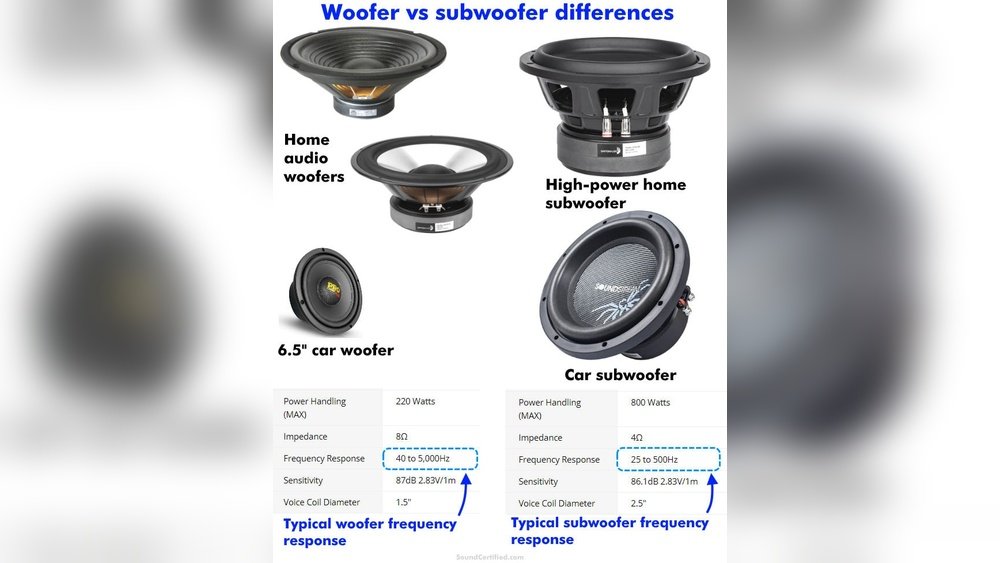
| Frequency Range | Usually 60 Hz to 20,000 Hz | Typically 20 Hz to 200 Hz |
| Purpose | Plays full audio (voices, music, effects) | Plays only deep bass sounds |
| Size | Varies (small to large) | Usually large and heavy |
| Placement | Usually at ear level | Can go anywhere in the room |
| Power Needs | Often powered by receiver/amp | Often has built-in amp (active) |
Frequency Response
Speakers cover a wide range of frequencies, but struggle with deep bass. Most can only go down to 50-60 Hz before losing power. Subwoofers focus on the lowest range, sometimes reaching as low as 20 Hz, which is at the edge of human hearing.
Sound Role
A speaker’s job is to play all parts of music and soundtracks. Without a subwoofer, you may miss the feeling of a live concert or the rumble of a movie explosion. A subwoofer only plays the bass, so if you use one alone, you will not hear voices or instruments clearly.
Physical Design
Speakers come in many sizes, often with multiple drivers (woofers, tweeters, midrange). Subwoofers have one large driver and a specially designed box to boost bass.
Placement And Setup
Speakers are placed for the best stereo or surround effect, usually facing the listener at ear level. Subwoofers can be placed almost anywhere, since deep bass is not as directional to our ears. However, placement still matters for the best sound.
Why Both Are Needed For Great Sound
Many people ask, “Can I just use speakers or just a subwoofer? ” The answer is almost always no, if you want full, rich sound.
Speakers Alone
If you use only speakers, you will hear voices, music, and effects clearly. But you may notice something is missing—there’s no deep punch or rumble, especially in movies or dance music. The sound may feel thin or weak.
Subwoofer Alone
A system with only a subwoofer will sound strange. You will feel bass, but not hear voices, guitars, or melodies. It’s like listening to music underwater.
Working Together
When you combine both, you get a complete sound experience:
- Speakers handle all the details—voices, instruments, and high notes.
- Subwoofers add the “feel” of sound—the bass you sense in your chest.
This is why most home theater systems have both, and why car audio systems use subwoofers for strong bass.
Technical Differences Explained
Some differences are easy to hear, but others are more technical. Here are a few details that beginners often miss.
Crossover Frequencies
A crossover is a filter that sends only certain frequencies to each speaker. In a home theater:
- The subwoofer gets only bass (below 80–120 Hz)
- The main speakers get everything else
Setting the crossover correctly is important. If it’s set too high, the subwoofer may play voices, which sounds odd. If it’s too low, you lose some bass.
Impedance And Power Handling
Speakers often have an impedance (resistance) of 4, 6, or 8 ohms. Subwoofers may be different, especially in car audio (sometimes 2 ohms). Matching the right amplifier is important to avoid damage or poor sound.
Power handling is also key. Subwoofers need more power to move air, so they are often rated for higher wattage.
Enclosure Design
A speaker’s box (or enclosure) changes how it sounds. Subwoofers use sealed, ported, or bandpass boxes to boost bass. Regular speakers may use open or closed boxes, or even no box at all (as in some wall-mounted designs).
Sensitivity
Sensitivity means how loud a speaker or subwoofer plays with a certain amount of power. Subwoofers are usually less sensitive, needing more power to reach the same loudness.
Subwoofers Vs. Speakers: Real-world Examples
It’s easier to understand the difference with real examples.
Home Theater
Imagine watching a movie with explosions, car chases, and deep music. With only regular speakers, the sound is clear but lacks excitement. Add a subwoofer, and you feel the thunder and action. The movie becomes more immersive.
Music Listening
If you enjoy classical, jazz, or acoustic music, good speakers will let you hear every detail. For electronic, hip-hop, or rock music, a subwoofer adds the deep bass that makes you want to dance.
Gaming
Games use sound to create atmosphere and excitement. Subwoofers add power to gunshots, footsteps, and effects, making the experience more real.
Car Audio
Car speakers are small and often weak in bass. Adding a subwoofer transforms the sound, letting you feel the music even with road noise.
Credit: www.arylic.com
Pros And Cons Of Subwoofers And Speakers
Each part has strengths and weaknesses. Here’s a quick look:
| Aspect | Speakers | Subwoofers |
|---|---|---|
| Sound Quality | Handles mids and highs well, weak in bass | Excellent for deep bass, cannot play mids/highs |
| Size | Compact to large | Usually large/heavy |
| Cost | Wide price range | Often expensive, especially high-power models |
| Setup | Simple for basic systems | Needs tuning and placement |
| Use Case | General audio, voices, music | Home theater, music with strong bass |
How To Choose: Subwoofer Or Speaker (or Both)?
Choosing between subwoofers and speakers depends on your needs, space, and budget. Here’s what to consider:
1. What Will You Listen To?
- Movies or games: You need both. Subwoofers add realism.
- Talk radio, podcasts: Speakers alone are fine.
- Music: Depends on style. For classical, jazz, and vocals, good speakers are enough. For electronic, hip-hop, or rock, a subwoofer improves the experience.
2. Room Size And Shape
Larger rooms need bigger speakers and subwoofers to fill the space with sound. Small rooms can use compact systems, but may still benefit from a small subwoofer.
3. Budget
Speakers come in all price ranges. Subwoofers add cost, especially for quality models. If your budget is tight, start with good speakers, then add a subwoofer later.
4. Placement
Subwoofers can be hidden in corners or under furniture. Speakers need to face the listener for best effect.
5. Matching Components
Make sure your receiver or amplifier can handle both your speakers and subwoofer. Many modern receivers have a special output for subwoofers (labeled “SUB OUT” or “LFE”).
Common Mistakes Beginners Make
Buying the wrong size: Many people buy a huge subwoofer for a small room, causing too much bass and shaking.
Ignoring crossover settings: If you don’t set the crossover right, the subwoofer and speakers may “fight” each other, making sound muddy.
Placing subwoofers poorly: Putting the subwoofer in a corner or blocking it with furniture can cause weak or uneven bass.
Using subwoofer alone: A subwoofer by itself cannot play music or voices correctly.
Not tuning the system: Every room is different. Use the subwoofer’s controls (volume, phase, crossover) to match your speakers and space.
Do You Always Need A Subwoofer?
Not every system needs a subwoofer. If you mostly listen to podcasts, audiobooks, or talk radio, good speakers are enough. If you want excitement in music, movies, or games, a subwoofer makes a big difference. Some high-end speakers have built-in bass that’s strong enough for small rooms, but for most people, a separate subwoofer is the best way to get true, deep bass.
Tips For Getting The Best Sound
- Choose quality over size: A good small subwoofer often sounds better than a cheap big one.
- Place the subwoofer wisely: Move it around the room to find where the bass sounds best.
- Set crossover carefully: Start at 80 Hz, then adjust by ear.
- Balance volume: The subwoofer should blend with the speakers, not overpower them.
- Use test tones or music you know well: This helps tune the system for your taste.
Remember, the goal is to create a system where every part works together. You want clear voices, detailed music, and bass you can feel—not just hear.
Advanced Insights: What Most Beginners Miss
Room Acoustics Matter
Your room changes how bass sounds. Hard walls, carpets, and furniture all affect audio. Sometimes, the best upgrade is simple: move your subwoofer or speakers, or add a rug.
Not All Subwoofers Are The Same
Some subwoofers are designed for music, others for movies. Music subwoofers are fast and tight, while movie subwoofers are powerful and deep. Think about what you like before buying.
Phase Control
Many subwoofers have a phase switch. This helps line up the sound from the subwoofer with your main speakers, so bass is strong and clear. If bass sounds weak, try flipping the switch.

Credit: www.youtube.com
Comparing Popular Brands And Models
For those starting out, it helps to know which brands are trusted for speakers and subwoofers.
- Speakers: Sony, Klipsch, Polk Audio, JBL, KEF, Bowers & Wilkins
- Subwoofers: SVS, Klipsch, Polk Audio, Yamaha, REL Acoustics
Each has models for beginners to advanced users. Always check reviews and listen before buying if possible.
For more technical details, the Wikipedia Subwoofer page is a solid resource.
Frequently Asked Questions
What Is The Main Difference Between A Subwoofer And A Speaker?
A subwoofer plays only deep bass sounds (usually below 100 Hz), adding power and “feel” to music and movies. A speaker plays all other sounds—voices, instruments, and high notes. Both are needed for a complete sound system.
Can I Use A Subwoofer Without Speakers?
No. A subwoofer alone cannot play voices or most music notes. You will only hear bass rumbles. Use speakers for clear sound, and a subwoofer for extra bass.
Do All Sound Systems Need A Subwoofer?
Not always. If you listen to talk radio or gentle music, speakers alone are fine. For movies, games, or bass-heavy music, a subwoofer is a big improvement.
Where Should I Place My Subwoofer For The Best Sound?
Start by placing the subwoofer near your main speakers or in a front corner of the room. Move it around and listen for strong, even bass. Avoid blocking it with furniture.
How Do I Connect A Subwoofer To My System?
Most home theater receivers have a dedicated “SUB OUT” or “LFE” jack. Use an RCA cable to connect this to the subwoofer’s input. Set the crossover frequency on the receiver or subwoofer for smooth sound.
Credit: www.youtube.com
Final Thoughts
Knowing the difference between subwoofers and speakers is key to building a sound system you’ll love. Speakers bring clarity and detail; subwoofers add excitement and depth. Together, they create an experience that makes music, movies, and games come alive. Take time to match your system to your needs, room, and taste. With a little care, you can enjoy sound that’s not just heard, but truly felt.