How Do You Wire a Dual Voice Coil Subwoofer: Easy Guide
Wiring a dual voice coil subwoofer can seem complicated, especially for beginners. Still, it’s a key step to getting clear, powerful bass in your car or home audio system. Understanding how to wire your subwoofer the right way not only improves sound quality but also protects your equipment from damage. In this guide, you’ll discover what a dual voice coil (DVC) subwoofer is, why wiring matters, and the exact steps to wire it for different setups. Whether you want louder bass or a better match with your amplifier, you’ll find clear answers here.
What Is A Dual Voice Coil Subwoofer?
A dual voice coil subwoofer is a type of subwoofer with two separate voice coils. Each coil has its own set of terminals. This design gives you more flexibility in wiring, allowing you to match the subwoofer’s impedance (measured in ohms) with your amplifier. For example, a DVC subwoofer rated at 4 ohms per coil can be wired for a total impedance of either 2 ohms or 8 ohms, depending on how you connect the coils.
Key Features Of Dvc Subwoofers
- Two voice coils: Each with positive (+) and negative (–) terminals
- Flexible wiring options: Can be wired in series or parallel
- Better amplifier matching: Easier to get the best power output and sound
Why Use Dvc Subwoofers?
- More wiring choices: Useful if you have multiple subwoofers or a complex audio system
- Optimized power: Helps you use your amplifier’s full potential without distortion
- Custom setups: Great for both car audio and home theaters
Key Terms You Need To Know
Before you start, it’s important to understand a few basic terms:
- Impedance (Ohms): The resistance to electrical current. Lower ohms usually mean more power.
- Series wiring: Connecting coils end to end, increasing the total impedance.
- Parallel wiring: Connecting coils side by side, decreasing the total impedance.
- Amplifier stable load: The lowest impedance your amplifier can safely handle.
What You Need To Wire A Dvc Subwoofer
Before wiring, gather these items:
- Your DVC subwoofer
- High-quality speaker wire (14- to 16-gauge is common)
- Wire strippers and cutters
- Screwdriver (for terminals)
- Amplifier (make sure you know its minimum impedance)
Having everything ready will make the job faster and safer.
Understanding Series Vs. Parallel Wiring
The way you wire your DVC subwoofer changes the total impedance. This matters because your amplifier works best with a certain load. Here’s a simple comparison:
| Wiring Type | Resulting Impedance (for 4-ohm coils) | Sound Output | When to Use |
|---|---|---|---|
| Series | 8 ohms | Lower volume, higher control | For amplifiers that need higher impedance |
| Parallel | 2 ohms | Higher volume, more power | For amplifiers stable at low impedance |
Insight: Many beginners think lower impedance is always better. But if your amplifier isn’t rated for 2 ohms, wiring in parallel can cause overheating or damage.
Credit: support.garmin.com
Step-by-step: Series Wiring (higher Impedance)
Wiring your subwoofer in series increases the total impedance. Here’s how to do it with a 4-ohm DVC subwoofer:
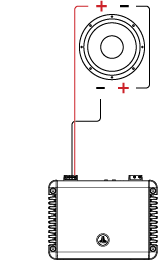
- Connect the positive (+) terminal of voice coil 1 to the amplifier’s positive output.
- Connect the negative (–) terminal of voice coil 1 to the positive (+) terminal of voice coil 2.
- Connect the negative (–) terminal of voice coil 2 to the amplifier’s negative output.
This setup makes the amplifier “see” an 8-ohm load. It’s a safe option if your amplifier can’t handle low impedance.
Example: If you have a mono amplifier that’s only stable down to 4 ohms, wiring your 4-ohm DVC subwoofer in series is the safest choice.
Step-by-step: Parallel Wiring (lower Impedance)
Parallel wiring gives your amplifier a lower impedance, pulling more power from it.
- Connect both positive (+) terminals of the subwoofer coils together.
- Connect both negative (–) terminals together.
- Run one wire from the combined positives to the amplifier’s positive output.
- Run one wire from the combined negatives to the amplifier’s negative output.
With two 4-ohm coils, this creates a 2-ohm load. This setup is popular for more bass, but only use it if your amplifier is “2-ohm stable. ”
Pro tip: Some amps advertise “2-ohm stable” but may overheat with long, heavy use at high volume. Always check reviews and specs.
How To Wire Multiple Dvc Subwoofers
You can use DVC subwoofers in pairs or more for even more powerful sound. The wiring gets more complex, but the basic rules are the same.
Example: Two 4-ohm Dvc Subwoofers
Let’s compare possible wiring results for two subs:
| Wiring Method | Total Impedance | When to Use |
|---|---|---|
| All coils in series | 16 ohms | Rare, usually too high for most amps |
| Series-parallel | 4 ohms | Common for mono amps rated at 4 ohms |
| All coils in parallel | 1 ohm | Only if your amp can handle 1-ohm loads |
Non-obvious insight: Many beginners wire two subs all in parallel and overload their amplifier. Always add up the total impedance before connecting.
Common Wiring Mistakes And How To Avoid Them
- Mismatched impedance: Always check your amplifier’s manual. Never connect a load lower than the amp’s rating.
- Loose connections: Make sure wires are tightly screwed into terminals. Loose wires cause noise and can damage equipment.
- Wrong wire gauge: Use at least 14-gauge for short runs, 12-gauge for longer runs or high-power systems.
- Skipping polarity check: Positive to positive, negative to negative. Mixing these causes weak or “out of phase” sound.
- Overlooking amplifier stability: Not all amps can handle 2-ohm or 1-ohm loads. If unsure, wire for higher impedance.
Credit: retailer.ru
Practical Example: Wiring A 4-ohm Dvc Subwoofer To A Mono Amp
Suppose you have a 4-ohm DVC subwoofer and a mono amplifier rated for “2 ohms stable.” Here’s how you’d wire for maximum power:
- Connect both positives together, both negatives together.
- Run one positive and one negative to the amp.
- The amp “sees” a 2-ohm load and delivers more power.
Tip: If your amplifier is only stable at 4 ohms, wire the subwoofer in series instead. This protects your gear and still gives you good bass.
How To Check Your Wiring
After you finish wiring:
- Double-check connections: Follow your wiring diagram again.
- Test with a multimeter: Measure the final impedance at the subwoofer terminals. For parallel wiring of two 4-ohm coils, you should see close to 2 ohms.
- Listen for distortion: Play music at low volume first. If you hear crackling or weak sound, recheck wiring.
Best Practices For Safe And Effective Wiring
- Use quality wire: Oxygen-free copper is best for clear sound and durability.
- Keep wire runs short: Long wires cause resistance and power loss.
- Label your wires: Especially if wiring multiple subwoofers. It saves time if you need to troubleshoot.
- Secure wires away from metal edges: Prevents short circuits and damage.
Matching Subwoofer Wiring To Amplifier Type
Not all amplifiers are the same. Your wiring choice depends on the amp:
| Amplifier Type | Best Wiring Method | Why |
|---|---|---|
| Mono (Class D) | Parallel or series, as needed | Flexible, handles low impedance well |
| 2-channel | Bridge channels, use higher impedance | Often safer at 4 ohms or higher |
| Multichannel | Wire for higher impedance | Most aren’t stable below 4 ohms |
Troubleshooting: What If The Bass Sounds Weak Or Distorted?
Poor sound usually means a wiring problem. Here’s what to check:
- Polarity: Make sure all positives go to positives, all negatives to negatives. Reverse polarity causes weak or “cancelled” bass.
- Impedance mismatch: If the amp isn’t stable at your wiring’s impedance, it may protect itself by lowering volume or shutting off.
- Loose wires: Even one loose terminal can reduce power and sound quality.
Advanced Wiring: Wiring For Multiple Amplifiers
Some advanced systems use more than one amp. In that case:
- Divide subwoofers among amps: Don’t try to wire one subwoofer to two amplifiers unless your system is designed for it.
- Match impedance to each amp: Wire each sub’s coils to fit the amp’s stable load.
- Use distribution blocks: For power and ground, to keep wiring safe and neat.
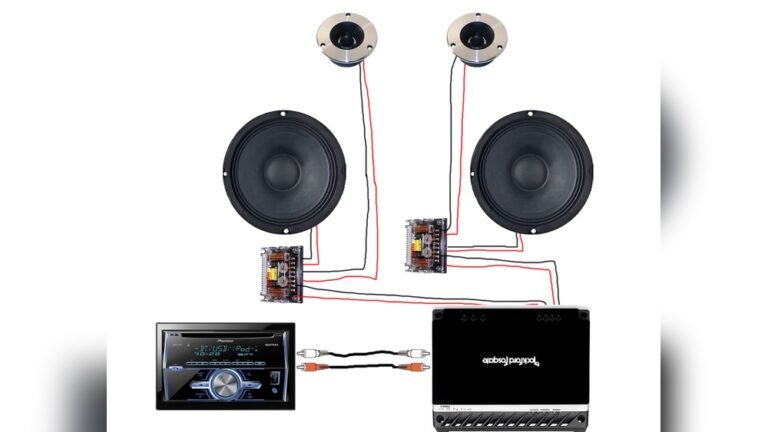
How To Read Wiring Diagrams
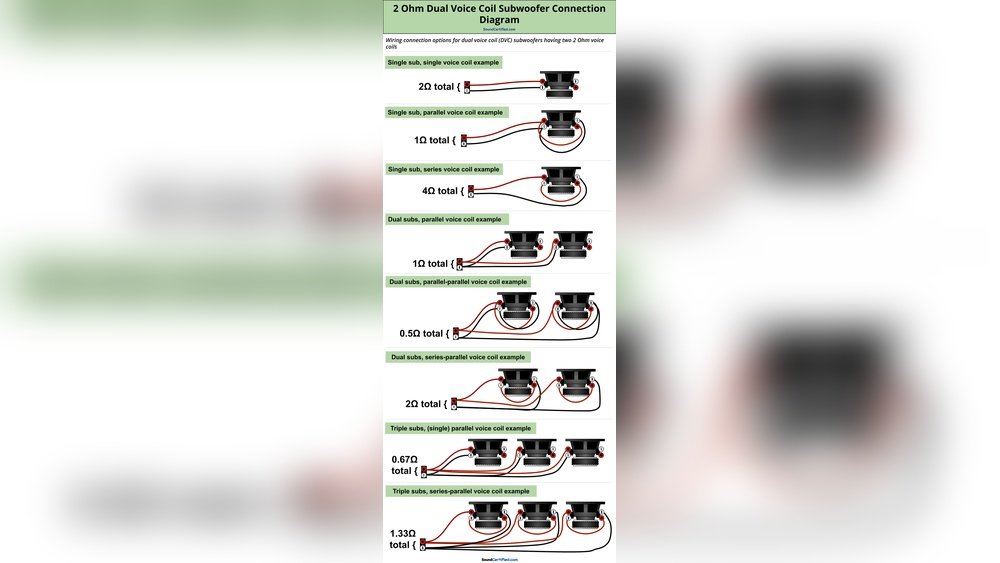
Most subwoofer manufacturers include wiring diagrams in their manuals or on their websites. These diagrams show:
- Which terminals to connect
- How to wire for series or parallel
- What the final impedance will be
If you’re unsure, search for your subwoofer’s model number plus “wiring diagram.” Sites like Crutchfield have helpful guides and diagrams.
Should You Use A Professional Installer?
Wiring a DVC subwoofer is a doable project for most beginners. But if you’re not comfortable with tools or your system is complex, consider hiring a pro. An expert installer can:
- Recommend the safest, most powerful setup
- Prevent costly mistakes
- Tidy up wiring for a clean look

Credit: soundcertified.com
Frequently Asked Questions
What Is The Main Advantage Of A Dual Voice Coil Subwoofer?
Dual voice coil subwoofers give you more choices for wiring. You can match the subwoofer’s impedance to your amplifier, getting better sound and more power options than with a single voice coil sub.
Can I Wire A Dvc Subwoofer With Only One Coil?
It’s possible, but not recommended. Using just one coil means you waste the subwoofer’s full potential and may not get the best sound. Always use both coils for safe, high-quality performance.
What If My Amplifier Is Not Stable At 2 Ohms?
If your amp cannot handle 2 ohms, wire your subwoofer in series. This increases the impedance and protects your amplifier. Never wire below your amp’s stable load rating.
How Do I Know Which Wiring Method Is Best For My Setup?
Check your amplifier’s specs. If it says “2-ohm stable,” you can wire in parallel for maximum power. If not, use series wiring. It’s always safer to use higher impedance than risk damaging your equipment.
Are There Any Tools To Help With Subwoofer Wiring?
Yes, tools like wiring calculators and online diagrams are very helpful. Use a multimeter to check your final impedance before turning on your amplifier.
Getting the most out of your dual voice coil subwoofer is all about wiring it correctly. Take your time, double-check each connection, and always match the wiring to your amplifier’s abilities. With these tips, you can enjoy deep, clean bass without worry.