How Do You Measure a Subwoofer: Expert Tips for Perfect Sound
How Do You Measure A Subwoofer
If you want to get the best sound from your audio system, knowing how to measure a subwoofer is important. Whether you are replacing an old subwoofer, building a custom box, or just checking compatibility, the right measurement makes a big difference.
Many beginners think measuring is just about the diameter, but there is more to consider. This guide will show you, step by step, how to measure a subwoofer the right way and avoid common mistakes.
Why Subwoofer Measurement Matters
A subwoofer produces deep bass frequencies that regular speakers cannot handle well. The way you measure it impacts:
- Sound quality: The right size fits the enclosure and matches the amplifier.
- Compatibility: Prevents buying the wrong size for your car or home system.
- Performance: Proper measurement avoids distortion and damage.
Measuring a subwoofer is not just about width. You also need to know the mounting depth, cutout diameter, and other details. Let’s break down the key measurements.
Main Measurements Of A Subwoofer
You will need a tape measure, ruler, and sometimes a caliper for small details. Here are the main subwoofer dimensions you should know:
- Overall Diameter: The distance across the widest part of the subwoofer, including the mounting frame.
- Cutout Diameter: The hole size needed in the box or panel for the subwoofer to fit.
- Mounting Depth: How deep the subwoofer sits inside the enclosure.
- Mounting Height: How far the subwoofer sticks out from the mounting surface.
- Displacement: The internal volume taken up by the subwoofer inside the enclosure.
- Voice Coil Diameter: Relevant for matching amplifiers and understanding power handling.
Let’s look at each one with simple, practical steps.

Credit: www.tonmeister.ca
How To Measure Subwoofer Diameter
Step-by-step Guide
1. Remove The Subwoofer
If possible, take the subwoofer out of the box or panel. This avoids measuring errors caused by the enclosure.
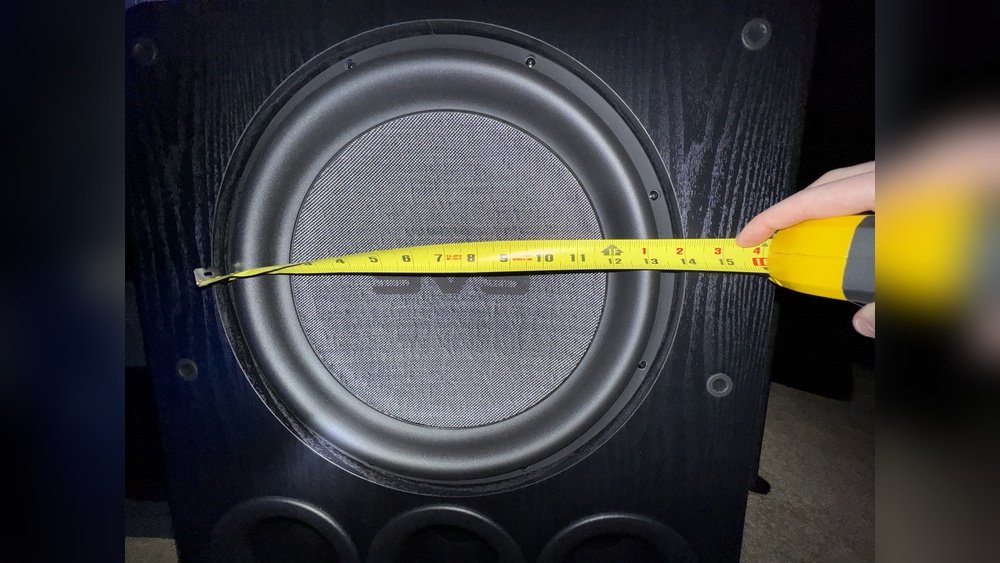
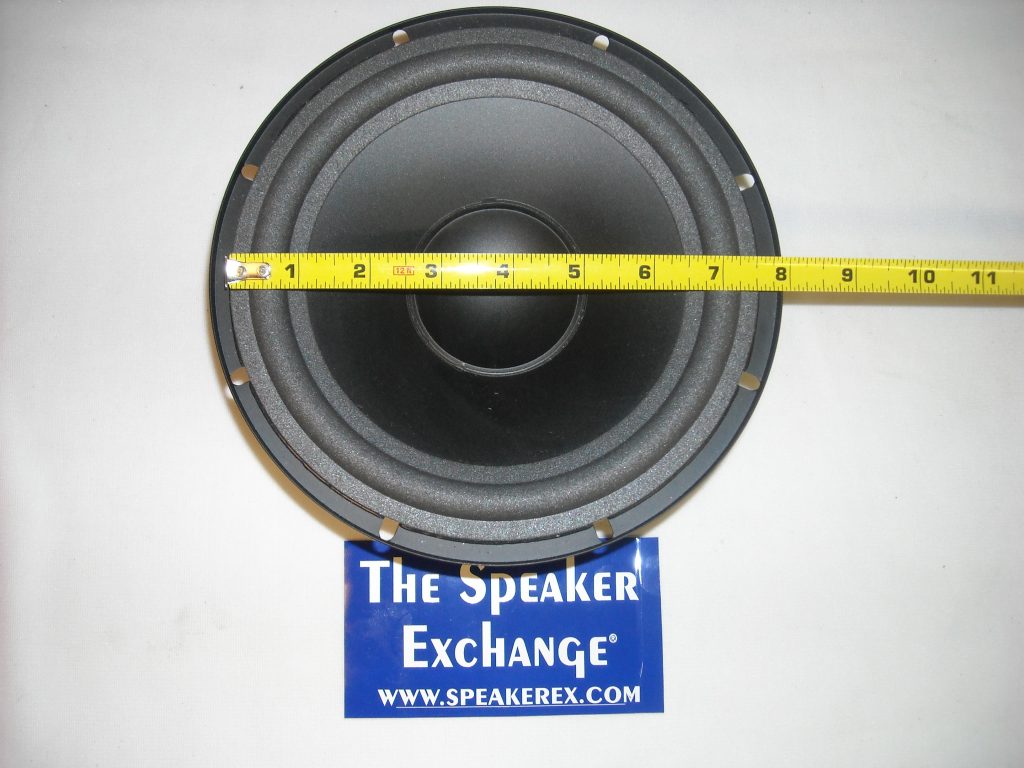
2. Find The Widest Point
Place the tape measure across the center of the cone, from one edge of the mounting frame to the opposite edge.
3. Read The Measurement
Record the number in inches. Most subwoofers are sold as 8”, 10”, 12”, or 15”.
Example:
If the widest part measures 12.3 inches, it is a 12-inch subwoofer (sizes are rounded).
Beginner Tip:
Don’t measure only the cone; always include the mounting frame.
Cutout Diameter And Why It Matters
The cutout diameter is the size of the hole the subwoofer fits into.
- Place the subwoofer face down.
- Measure the diameter of the part that sits inside the enclosure (not the frame).
- This size is always less than the overall diameter.
Example:
A 12-inch subwoofer might have a cutout diameter of about 11. 1 inches.
Why is this important?
If the cutout is too small, the subwoofer won’t fit. If it’s too big, you lose air seal and sound quality.
Credit: www.avsforum.com
Measuring Mounting Depth
Mounting depth is how deep the subwoofer sits inside the box or panel.
- Place the subwoofer on a flat surface, cone facing up.
- Measure from the bottom of the mounting frame to the bottom of the magnet.
- This tells you how deep your enclosure needs to be.
Example:
A typical 12-inch subwoofer might have a mounting depth of 6. 5 inches.
Pro Tip:
Always check for extra space so the magnet doesn’t touch the back wall of your enclosure.
Subwoofer Displacement: The Hidden Space Taker
Displacement is the space inside the enclosure taken up by the physical body of the subwoofer.
- Check the manufacturer’s specs for this number.
- If not available, you can estimate it by measuring the volume of the subwoofer’s basket and magnet.
Why does this matter?
When building a subwoofer box, you must subtract this volume from the total box size to get accurate enclosure tuning.
Example:
A subwoofer may displace 0. 10 cubic feet. If your box is 1. 00 cubic foot, only 0. 90 cubic feet is for air.
Mounting Height: Don’t Overlook This
Mounting height is how much the subwoofer sticks out from the mounting surface.
- Place the subwoofer in the mounting position.
- Measure from the mounting surface to the top of the subwoofer cone or grille.
This matters for tight spaces—like car doors or custom furniture—where height is limited.
Comparing Subwoofer Sizes
To help you see the main differences, here’s a comparison of popular subwoofer sizes:
| Size (inches) | Overall Diameter (inches) | Cutout Diameter (inches) | Mounting Depth (inches) | Typical RMS Power (Watts) |
|---|---|---|---|---|
| 8 | 8.1 – 8.5 | 7.2 – 7.6 | 3.5 – 4.5 | 150 – 300 |
| 10 | 10.1 – 10.6 | 9.1 – 9.6 | 4.5 – 6.0 | 200 – 500 |
| 12 | 12.1 – 12.6 | 11.1 – 11.6 | 5.5 – 7.0 | 300 – 1000 |
| 15 | 15.1 – 15.6 | 14.1 – 14.6 | 6.0 – 8.0 | 500 – 1500 |
RMS Power is the continuous power the subwoofer can handle. Size affects both the enclosure needed and the power you need from an amplifier.
Key Specs On The Subwoofer Label
Most subwoofers have a label or manual with important specs. Look for:
- Model number
- Impedance (measured in ohms, like 2Ω or 4Ω)
- RMS and Peak Power
- Sensitivity (dB)
- Frequency Response (Hz range)
Example:
A label might read:
Model: SW12X4 | Impedance: 4Ω | RMS Power: 600W | Sensitivity: 88dB | Freq. Response: 25-200Hz
If you see a lot of numbers, focus on diameter, mounting depth, and cutout diameter for measuring.
How To Measure A Subwoofer In A Box
Sometimes, the subwoofer is already installed and you can’t remove it. Here’s how to measure:
- Remove the grill or protective cover.
- Use a flexible tape measure.
Place it across the cone and measure the diameter of the visible part, then add 1 to 1. 5 inches for the mounting frame.
3. Estimate The Cutout Diameter.
If you can see the edge of the box opening, measure that directly.
4. Guess The Mounting Depth.
If access is limited, check the model number and look up the specs online.
Beginner Insight:
Never force the subwoofer out if you’re unsure—this can damage the wiring.
Measuring Subwoofer Impedance
Impedance tells you how much resistance the subwoofer gives to the amplifier. Most common values are 2Ω or 4Ω.
- Set a digital multimeter to the Ohms (Ω) setting.
- Touch the probes to the two main speaker terminals.
- Read the value on the screen.
Example:
If the reading is 3.8Ω, it’s a 4-ohm subwoofer (slight variations are normal).
Pro Tip:
Knowing the correct impedance prevents blowing your amplifier or underpowering your subwoofer.
Measuring Frequency Response
Most beginners overlook frequency response. This is the range of bass notes your subwoofer can play.
- Check the manufacturer’s specs. It’s usually written as “25Hz – 200Hz”.
- Lower “Hz” means deeper bass.
Non-obvious insight:
Two subwoofers of the same size can have different frequency responses. Always check the specs if you want very deep bass.
Practical Example: Measuring A 12-inch Subwoofer
Let’s walk through a real example:
- Remove the subwoofer from the box.
- Measure the overall diameter: 12.3 inches (so, a 12” subwoofer).
- Measure the cutout diameter: 11.2 inches.
- Measure the mounting depth: 6.6 inches.
- Check the label: 4Ω, 500W RMS, 85dB sensitivity.
- Use a multimeter: Reads 3.7Ω (matches the label).
Now you know exactly what enclosure size and amplifier you need.
Comparing Subwoofer Types
Subwoofers come in different types. Here’s a simple comparison:
| Type | Best Use | Mounting Depth | Sound Quality |
|---|---|---|---|
| Standard | Home & Car Audio | Medium-High | Deep, balanced |
| Shallow Mount | Small spaces (cars) | Low | Good, less deep bass |
| Powered | Plug-and-play setups | Medium | Convenient, less power |
Shallow mount subwoofers are easier to fit in tight spaces but may not go as deep as standard ones.
Credit: reconingspeakers.com
Common Measurement Mistakes
Beginners often make these mistakes:
- Measuring only the cone, not the frame.
- Forgetting about mounting depth.
- Ignoring displacement when building a box.
- Not checking impedance before connecting to an amp.
- Estimating with poor tools (like a string instead of a tape measure).
Avoid these for better sound and longer equipment life.
When To Check Subwoofer Measurements
- Before buying a new subwoofer.
- When building or buying an enclosure.
- If upgrading your amplifier.
- When sound quality is poor (to check for mismatches).
Extra Insights Most Guides Miss
- Subwoofers can have different frame shapes (round, square, etc. ), so always measure at the widest point.
- Double-check with the manufacturer’s website for precise specs. Sometimes, labels are outdated or worn off.
- Even a small error in cutout diameter can lead to air leaks, which greatly reduce bass quality.
For more details on subwoofer specifications, you can visit the Wikipedia Subwoofer page.
Frequently Asked Questions
How Do I Know What Size Subwoofer I Have?
Measure the widest part of the subwoofer, including the mounting frame. Round down to the nearest inch (for example, 12. 3 inches = 12-inch subwoofer).
What Tools Do I Need To Measure A Subwoofer?
You need a tape measure or ruler, and a digital multimeter for checking impedance. For more accuracy, a caliper can help with smaller parts.
Can I Measure The Subwoofer Without Removing It From The Box?
Yes, but results may be less accurate. Measure the visible cone and add about 1–1. 5 inches for the mounting frame. For depth, check the specs online if you know the model.
Why Does Mounting Depth Matter?
Mounting depth tells you how much space your subwoofer needs inside the enclosure. If the enclosure is too shallow, the subwoofer will not fit or may get damaged.
What Is Subwoofer Displacement, And Why Is It Important?
Displacement is the volume inside the enclosure taken up by the subwoofer. You must subtract this from the box’s total air space to get the correct tuning and bass performance.
Measuring a subwoofer correctly helps you get the most out of your audio system. With the right tools and attention to detail, you will avoid common mistakes and enjoy deep, powerful bass. Always double-check your measurements, and when in doubt, consult the manufacturer’s official specifications.
Accurate measurement is the foundation of great sound.