How to Wire 2 Subs in Separate Boxes: Easy DIY Guide
Wiring two subwoofers in separate boxes is a common project for car audio enthusiasts and home theater fans. Good bass can transform your music or movie experience. If you want deep, powerful sound, connecting two subs the right way is important.
But if you’re a beginner, the process can seem confusing. The good news? You can do it safely and correctly with a few basic tools and a clear plan.
In this article, you’ll learn everything you need to wire 2 subs in separate boxes. You’ll find practical steps, clear diagrams, and smart tips. By the end, you’ll know how to choose the right wiring method, connect your equipment, and avoid common mistakes. Let’s get started.
Why Use Separate Boxes For Subwoofers?
Choosing separate boxes for your subs is more than just a space decision. Here’s why many people prefer this setup:
- Better sound control: Each subwoofer gets its own air space, which helps produce cleaner, more accurate bass.
- Flexible placement: You can position each box for the best sound in your car or room.
- Easier upgrades: If you want to change one sub, you don’t have to touch the other.
- Less vibration: Separate boxes can reduce unwanted vibrations and rattles.
For example, in a car, placing subs on each side of the trunk can give a smoother bass response. At home, you can spread them out to avoid “dead spots” where bass disappears.
What You Need Before You Start
Before wiring your subs, gather these items. Having the right tools and parts makes your work easier and safer:
- Two subwoofers (same size and power rating preferred)
- Two subwoofer boxes (sealed or ported, matched to your subs)
- Amplifier (supports two subs, check power and ohm ratings)
- Speaker wire (usually 12- or 14-gauge, oxygen-free copper is best)
- Wire stripper and cutter
- Screwdriver
- Electrical tape or heat-shrink tubing
- Amplifier wiring kit (includes power cable, ground wire, RCA cables, fuse)
If you don’t already own an amp, look for one that matches the RMS power and impedance (ohm rating) of your subwoofers. Mismatched power can cause weak sound or even damage.
Credit: www.gmfullsize.com
Understanding Series Vs. Parallel Wiring
You must decide: series or parallel wiring? This affects how much load (resistance) your amp “sees” and how much power your subs get.
| Wiring Type | Resulting Ohms (2 x 4Ω Subs) | Power Output | Use When |
|---|---|---|---|
| Series | 8Ω | Lower | Amplifier is not stable at low ohms |
| Parallel | 2Ω | Higher | Amplifier is 2Ω stable |
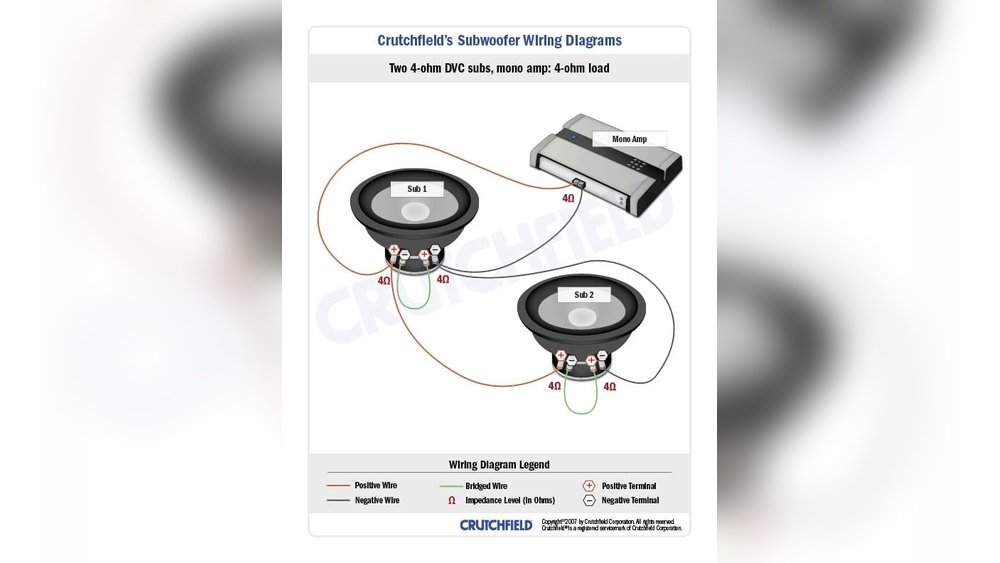
- Series wiring: Connects one sub’s positive to the amp’s positive, and its negative to the other sub’s positive; finally, the second sub’s negative goes to the amp’s negative. Result: higher ohms, less power.
- Parallel wiring: Connect both positives together and both negatives together, then to the amp. Result: lower ohms, more power.
Example: Two 4-ohm subs wired in series create an 8-ohm load. The same subs wired in parallel create a 2-ohm load. Most modern car amps are 2-ohm stable, so parallel is common for max power.
Non-obvious insight: If you wire below your amp’s minimum ohm rating, it can overheat or shut down. Always check your amp’s manual before starting.
Step-by-step: How To Wire 2 Subs In Separate Boxes
Let’s walk through the process. These steps work for both car and home setups, but always follow your amp’s safety instructions.
1. Plan Your Wiring Path
- Decide where you’ll place both sub boxes and the amplifier.
- Measure the distance for speaker wire—add a little extra for mistakes.
- Avoid running wires near power cables to reduce noise interference.
2. Prepare The Subwoofers And Boxes
- Mount each subwoofer securely into its box. Tighten screws evenly to prevent leaks.
- If your boxes have binding posts, use them for easy connections.
3. Cut And Strip Your Speaker Wire
- Cut two equal lengths of wire (one for each sub).
- Strip about 1/2 inch (1.3 cm) of insulation from each end.
4. Connect The Subwoofers (parallel Wiring Example)
Parallel is most common for beginners.
- Connect the positive terminal of sub 1 to the amp’s positive output.
- Connect the positive terminal of sub 2 to the same amp positive output.
- Repeat for the negative terminals.
- Use crimp connectors, solder, or screw-down terminals for secure contact.
Series Wiring (if needed):
- Connect the amp’s positive to sub 1’s positive.
- Connect sub 1’s negative to sub 2’s positive.
- Connect sub 2’s negative to the amp’s negative.
5. Secure And Test Connections
- Double-check for loose wires or stray strands that could cause short circuits.
- Use electrical tape or heat-shrink tubing on exposed metal.
- Gently pull wires to ensure a snug fit.
6. Connect To The Amplifier
- Insert the positive and negative wires into the amp’s speaker outputs.
- Tighten screws or connectors firmly.
- Avoid mixing up the channels—left and right should match.
7. Power Up And Test
- Set your amplifier’s gain to the lowest setting before turning it on.
- Play a test tone or music with bass.
- Slowly increase the gain until you hear clean, powerful bass.
- Listen for rattles, buzz, or distortion—these mean a connection problem.
Advanced tip: If your amp has a built-in crossover, set it to “low-pass” (usually 80 Hz) to send only bass to your subs.

Credit: www.stevemeadedesigns.com
Real-world Example: Wiring Two 4-ohm Subs To A 2-channel Amp
Suppose you have:
- Two 4-ohm, 300W RMS subwoofers
- A 2-channel amp rated for 2 ohms per channel
- Two separate sealed sub boxes
Best method: Parallel wiring, one sub per channel. Here’s how:
- Wire sub 1 directly to channel 1 (positive to positive, negative to negative).
- Wire sub 2 to channel 2 the same way.
- Set both amp channels to “low-pass” and adjust the gain.
This gives each sub full power and keeps the amp safe.
Pro tip: If your amp is “bridged” (combines channels), only use it if the manual says it supports your wiring type and ohm load.
Common Mistakes To Avoid
Even a small error can damage your equipment. Watch out for these problems:
- Mismatched subs: Using different ohm or watt ratings can cause uneven sound and stress the amp.
- Too thin wire: Always use at least 14-gauge for short runs, 12-gauge for longer or high-power setups.
- Incorrect polarity: If one sub is wired “backwards,” bass will sound weak or “hollow.”
- Skipping the fuse: Always use a fuse on your amp’s power line to prevent fire hazards.
- Ignoring amp ratings: Never wire to a lower ohm load than your amp supports.
Credit: www.diymobileaudio.com
Matching Amplifier Power And Subwoofer Specs
If you want your subs to last, match your amp’s RMS power to your subs’ RMS rating.
- RMS (Root Mean Square) is continuous power, not “peak” (which is much higher but only for a second).
- For two 300W RMS subs, your amp should supply about 600W RMS (300W per channel or 600W bridged).
Here’s a quick reference for choosing wire gauge:
| Wire Gauge | Max Length (ft) | Max Power (Watts) |
|---|---|---|
| 14 | 25 | 200 |
| 12 | 35 | 400 |
| 10 | 50 | 700 |
Non-obvious insight: Always round up your wire size if you’re close to the limit. Thicker wire reduces power loss and keeps your bass strong.
Practical Tips For Best Sound
- Place boxes away from walls or corners to avoid “boomy” bass.
- Use sound-deadening material in your car or room to cut rattles.
- Tune your amp’s gain, bass boost, and crossover settings for smooth response.
- Check all connections every few months—vibration can loosen wires over time.
- If you hear distortion, turn down the gain. It’s better to have clean sound than loud distortion.
Safety Considerations
Working with amplifiers involves high current. Follow these safety steps:
- Disconnect your car’s battery before wiring.
- Never work with wet hands.
- Keep wires away from moving parts or hot surfaces.
- Secure all wiring with zip ties or clamps.
If you’re unsure, ask a pro installer or check reliable guides like Crutchfield.
Troubleshooting: If Your Subs Aren’t Working
Sometimes, you finish wiring and get no sound. Here’s what to check:
- Blown fuse: Replace with the same size.
- Loose connections: Re-tighten all terminals.
- Amp settings: Make sure input and output switches are correct.
- Phase switch: Try flipping the phase if bass is weak.
- Subwoofer health: Test each sub with a 9V battery—if it “pops,” the coil is good.
If you hear a “thump” but no music, check your RCA cables and source settings.
Frequently Asked Questions
What Is The Difference Between Series And Parallel Wiring For Subs?
Series wiring increases the resistance (ohms), which lowers the power each sub gets. Parallel wiring lowers the resistance, allowing more power from the amp. Most people use parallel for louder bass, but you must match the amp’s ohm rating.
Can I Wire Two Subs Of Different Sizes Or Power Ratings Together?
It’s not recommended. Different subwoofer sizes or power ratings will not share power evenly, and one may sound weaker or even get damaged. Use matching subs for best results.
What Happens If I Wire My Subs To The Wrong Polarity?
If one sub is wired “out of phase” (positive and negative reversed), bass will cancel out and sound weak or strange. Always double-check polarity before powering up.
How Much Power Do I Need For Two Subs?
Add the RMS ratings of both subs. For example, two 300W RMS subs need about 600W RMS from your amplifier. Too much or too little power can cause distortion or damage.
Do I Need A Special Amplifier For Two Subwoofers?
No, but your amp must support the total ohm load and power needed. Check the manual for “2-ohm stable” or “4-ohm stable” ratings. Some amps are “monoblock” (for subs only), while others are multi-channel.
Wiring two subs in separate boxes is a smart way to get powerful, clean bass. With the right parts, some planning, and careful wiring, you’ll enjoy music and movies like never before. Remember: safety first, match your equipment, and don’t rush. Happy listening!