How to Calculate Total Ohm Load on Amplifier: Easy Guide
Calculating the total ohm load on your amplifier is vital for both sound quality and safety. If the load is too high or too low, your amplifier could overheat, shut down, or even get damaged. Beginners often feel confused by terms like impedance, series, and parallel wiring. This guide breaks down the process step-by-step, uses simple words, and shows real examples so you can match speakers and amps confidently.
What Is Ohm Load?
The ohm load is the total resistance your speakers present to the amplifier. It’s measured in ohms (Ω). Most amplifiers are rated for 2, 4, or 8 ohms. Matching the amp’s rating with the speaker load prevents problems.
- Lower ohm load = more current drawn = higher risk for amp.
- Higher ohm load = less current = safer but less power.
Series And Parallel Wiring Explained
How you wire your speakers changes the total ohm load.
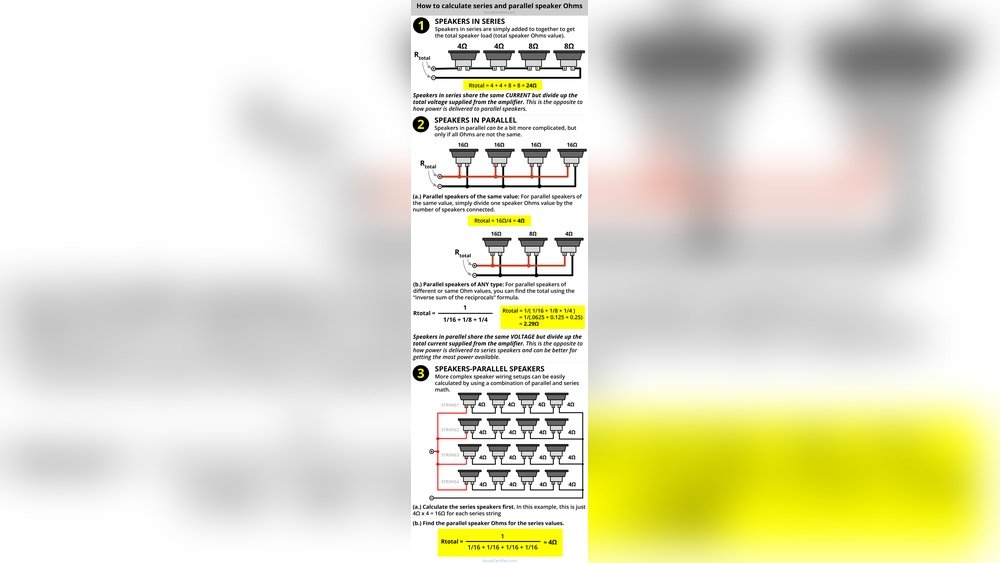
- Series Wiring: You connect speakers one after another. The total ohm load is the sum of all speaker impedances.
- Parallel Wiring: You connect speakers side by side. The total ohm load is calculated differently.
Example: Series Wiring
If you have two 4-ohm speakers wired in series:
- Total Ohm Load = 4Ω + 4Ω = 8Ω
Example: Parallel Wiring
For the same two 4-ohm speakers in parallel:
- Formula: 1 / Total Ohm Load = 1/4Ω + 1/4Ω
- 1 / Total = 0.25 + 0.25 = 0.5
- Total Ohm Load = 1 / 0.5 = 2Ω
Credit: www.guitartricks.com
Practical Calculation Steps
Follow these steps to calculate your total ohm load:
- Check Speaker Impedance: Look for the Ω rating on each speaker.
- Decide Wiring Type: Series or parallel.
- Use the Correct Formula:
- Series: Add all speaker impedances.
- Parallel: Use 1 / Total = 1/Ω1 + 1/Ω2 + 1/Ω3 …
Common Setups Comparison
Below is a comparison of two common setups:
| Setup | Number of Speakers | Impedance (Ω) | Wiring | Total Ohm Load |
|---|---|---|---|---|
| Home Stereo | 2 | 8 | Series | 16Ω |
| Car Subwoofer | 2 | 4 | Parallel | 2Ω |
Why Ohm Load Matters
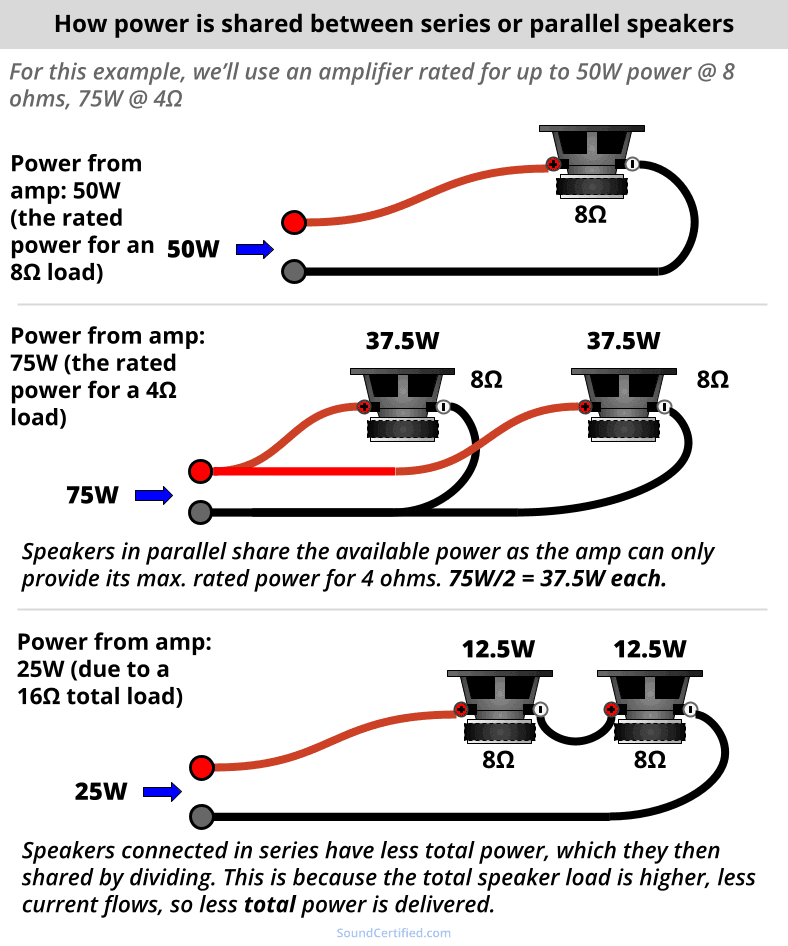
Matching your amplifier and speakers is critical. Too low an ohm load can cause:
- Overheating
- Amp shutdown
- Possible damage
Too high a load might lower volume but keeps your amp safe. Always check the amplifier’s minimum ohm rating.
Credit: soundcertified.com
Mistakes Beginners Make
Many people forget these key points:
- Don’t mix different speaker impedances in parallel.
- Never ignore the amp’s minimum ohm rating.
- Always double-check wiring before powering up.
Real-world Example
Suppose you have three 8-ohm speakers and wire them in parallel.
- 1 / Total = 1/8 + 1/8 + 1/8 = 0.375
- Total Ohm Load = 1 / 0.375 = 2.67Ω
This setup works if your amp supports a 2-ohm load. If not, consider series wiring.
| Number of Speakers | Speaker Impedance | Wiring | Calculated Ohm Load |
|---|---|---|---|
| 3 | 8Ω | Parallel | 2.67Ω |
| 3 | 8Ω | Series | 24Ω |
For more technical details on ohm load and safety, see this Wikipedia article.
Calculating the total ohm load is simple when you follow these steps. Use the formulas, check your amp’s rating, and avoid mixing speaker types. With correct wiring, your system will sound better and last longer.

Credit: audiouniversityonline.com
Frequently Asked Questions
What Is Speaker Impedance?
Speaker impedance is the resistance the speaker gives to current, measured in ohms (Ω). It affects how much power the amplifier delivers.
How Do I Know My Amplifier’s Minimum Ohm Load?
Check the amp’s manual or back panel for the minimum ohm rating. Most car amps support 2Ω, while home amps are usually 4Ω or 8Ω.
Can I Mix Different Speaker Ohm Ratings?
It’s best not to mix different impedance ratings in parallel, as it can cause uneven power and possible damage.
What Happens If I Use Too Low An Ohm Load?
Using too low an ohm load can cause the amp to overheat, shut down, or fail. Always match or exceed the amp’s minimum rating.
Is Series Or Parallel Wiring Better?
Series wiring is safer for amps but gives less power. Parallel wiring delivers more power but needs careful calculation to avoid low ohm loads.