How to Calculate Subwoofer Displacement: Easy Steps for Perfect Sound
Calculating subwoofer displacement is a key step when building or upgrading a speaker box. Many beginners overlook this, but ignoring displacement can lead to poor sound quality, wrong box size, or even damaging your subwoofer. If you want tight, accurate bass and a subwoofer that lasts, learning how to measure and subtract displacement is essential.
This guide will walk you through the process, using simple words, real examples, and easy-to-follow steps.
Why Subwoofer Displacement Matters
When you build a subwoofer box, you must know the internal air space. Most subwoofers take up space inside the box, which reduces the air volume. If you don’t account for the subwoofer’s displacement, your box will be too small. This can cause:
- Muddy or weak bass
- Poor frequency response
- Damaged speaker over time
Manufacturers usually provide a recommended box volume for their subwoofers (for example, 1. 25 cubic feet). If your subwoofer takes up 0. 10 cubic feet, your box should be built slightly larger to compensate. This way, the remaining air matches the recommended volume.
What Is Subwoofer Displacement?
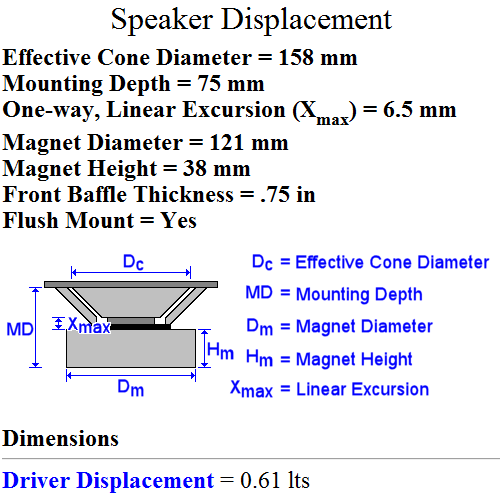
Subwoofer displacement is the amount of air space the physical body of the subwoofer occupies inside the enclosure. It includes the basket, magnet, and cone that sit inside the box. Some subwoofers have large magnets or deep baskets, so their displacement can be significant.
You’ll also need to include the displacement of:
- Bracing (wood pieces inside for strength)
- Ports (in ported boxes)
- Internal amplifiers (if present)
For now, this guide will focus mainly on the subwoofer itself.
Where To Find Subwoofer Displacement Information
The easiest way to find subwoofer displacement is to check the manufacturer’s specifications. Look for terms like:
- Mounting displacement
- Driver displacement
- Displacement
These are usually listed in cubic feet (ft³) or liters (L).
If the manufacturer gives you a number, use that. For example, if the spec sheet says “displacement: 0.15 ft³,” that’s the value you subtract from your box’s internal volume. If no value is given, you’ll need to measure and calculate it yourself.
How To Calculate Subwoofer Displacement Yourself
If you can’t find the spec, you can estimate the displacement by measuring your subwoofer. Here’s how you do it step-by-step:
1. Measure The Subwoofer
You’ll need a measuring tape, ruler, or caliper. Focus on the part of the subwoofer that sits inside the box.
Write down:
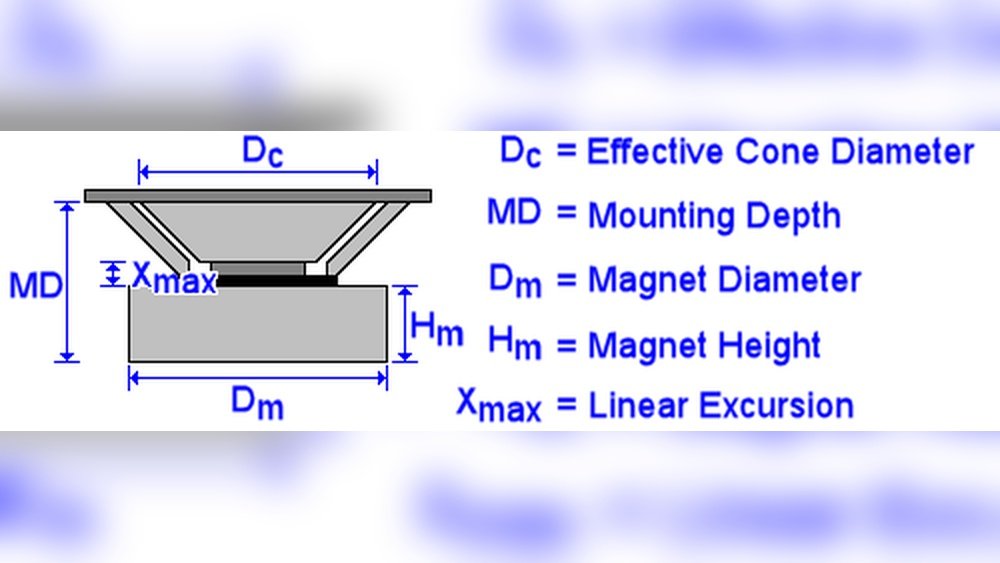
- Outside diameter of the basket (the part inside the box)
- Depth of the basket (from the mounting surface to the deepest point, usually the back of the magnet)
2. Estimate The Shape
Most subwoofers have a shape similar to a cylinder or a combination of a cylinder and a cone. For a basic estimate, treat it as a cylinder.
- Cylinder formula:
Volume = Π × (radius²) × Height
3. Calculate The Volume
Let’s use a real example:
- Basket diameter (inside the box): 12 inches
- Depth: 5 inches
First, get the radius (half the diameter):
12 Inches ÷ 2 = 6 Inches
Now, plug into the formula:
- Volume = π × (6²) × 5
- Volume = 3.1416 × 36 × 5
- Volume ≈ 3.1416 × 180
- Volume ≈ 565 cubic inches
But box volume is usually measured in cubic feet. Convert by dividing by 1,728 (the number of cubic inches in a cubic foot):
- 565 ÷ 1,728 ≈ 0.33 ft³
This is a rough estimate. Most subwoofers are not perfect cylinders; the magnet is smaller than the basket, so the real displacement is usually a bit less.
Example Table: Diameter, Depth, And Displacement
Below is a quick reference for common subwoofer sizes.
| Subwoofer Size | Estimated Depth | Estimated Displacement (ft³) |
|---|---|---|
| 8 inch | 4 inches | 0.08 |
| 10 inch | 4.5 inches | 0.12 |
| 12 inch | 5 inches | 0.18 |
| 15 inch | 7 inches | 0.35 |
These are estimates. Always check the real specs or measure yourself for accuracy.
Adjusting Box Volume For Displacement
Once you know the subwoofer displacement, you must subtract it from the internal box volume.
Example:
- Manufacturer says, “Box volume: 1.50 ft³”
- Subwoofer displacement: 0.18 ft³
Build your box to have an internal volume of 1.68 ft³ (1.50 + 0.18). After installing the subwoofer, the remaining air space will be 1.50 ft³, as recommended.
Including Displacement From Other Parts
Don’t forget to include the displacement from:
- Ports (for ported boxes)
- Bracing
- Internal amps or crossovers (if inside the box)
Each of these parts takes up space, just like the subwoofer. Ports are easy to calculate if you know their size.
Example:
- Round port with 4-inch diameter, 8-inch length
The volume of a cylinder:
- Radius: 2 inches
- Volume = π × (2²) × 8 = 3.1416 × 4 × 8 = 100.5 cubic inches
- In cubic feet: 100.5 ÷ 1,728 ≈ 0.058 ft³
Add this to the displacement calculation.
Credit: www.diyaudioandvideo.com
Step-by-step Guide: Calculating And Adjusting For Displacement
Here’s a simple way to get it right every time:
- Find the recommended box volume for your subwoofer (in cubic feet).
- Get the subwoofer’s displacement from the manufacturer or calculate it.
- Add bracing or port displacement if needed.
- Add up all displacements.
- Add this total to the recommended box volume to get your target internal box size.
- Build the box to this larger internal size.
- Install the parts. The final air space will be correct.
Common Mistakes Beginners Make
Many people skip these steps or make simple errors. Watch out for:
- Forgetting to subtract displacement: This is the most common mistake.
- Using outside box dimensions: Always use inside measurements.
- Missing bracing/port displacement: Every part inside matters.
- Rounding off measurements too much: Small errors add up.
- Trusting rough estimates: Always check your math and, if possible, measure.

Credit: www.youtube.com
Practical Example: Full Calculation
Suppose you have a 12-inch subwoofer with these specs:
- Recommended box: 1.25 ft³
- Subwoofer displacement: 0.18 ft³
- Port displacement: 0.06 ft³
- Bracing: 0.03 ft³
Total Displacement: 0.18 + 0.06 + 0.03 = 0.27 Ft³
Target Internal Box Volume: 1.25 + 0.27 = 1.52 Ft³
So, you build a box with an internal air space of 1. 52 ft³. After installing everything, you’ll have exactly the recommended 1. 25 ft³ of air left for the subwoofer to perform at its best.
Visualizing With A Comparison Table
Here’s a look at how different subwoofer and port sizes affect total displacement.
| Box Type | Sub Displacement (ft³) | Port Displacement (ft³) | Bracing (ft³) | Total Displacement (ft³) | Final Air Volume (ft³) |
|---|---|---|---|---|---|
| Sealed, 10” sub | 0.12 | 0 | 0.02 | 0.14 | Box size – 0.14 |
| Ported, 12” sub | 0.18 | 0.06 | 0.03 | 0.27 | Box size – 0.27 |
| Ported, 15” sub | 0.35 | 0.12 | 0.05 | 0.52 | Box size – 0.52 |
Credit: proline-x.com
Non-obvious Insights For Beginners
- Magnet Shape Matters: Not all subwoofers are shaped the same. Some have large, wide magnets or cooling fins that add extra displacement. Always check the back of your subwoofer—not just the cone.
- Bracing Adds Up: Even small wood pieces inside the box can add a lot of displacement. If you use thick bracing for a heavy subwoofer, measure those pieces and include their volume.
- Gasket and Mounting Depth: The foam gasket between the subwoofer and box adds a little height. If your box is small, this can make a difference. Always measure from the mounting surface to the deepest part.
- Double-Check Units: Manufacturers sometimes use liters instead of cubic feet. One cubic foot is about 28.3 liters. Convert units before adding or subtracting.
- Use Online Calculators: Many car audio websites have tools that let you enter your measurements and get instant displacement results. This can reduce mistakes.
Tools And Apps To Make It Easier
- Online calculators: Search for “subwoofer displacement calculator.” These let you enter diameter and depth for quick answers.
- 3D modeling apps: For complex subwoofers or enclosures, use SketchUp or similar 3D tools.
- Measuring tape and caliper: For physical measurements.
- Volume conversion websites: To convert between cubic inches, feet, and liters.
If you want reliable results without much math, try the online calculators from trusted sites like The12Volt.
Frequently Asked Questions
How Do I Find My Subwoofer’s Displacement If There’s No Spec Sheet?
You can estimate by measuring the diameter and depth of the part inside the box, then use the cylinder volume formula. For more complex shapes, split it into sections (for example, a cylinder plus a smaller magnet). If unsure, overestimate slightly to avoid making your box too small.
What Happens If I Forget To Subtract Subwoofer Displacement?
Your box will be smaller than needed. This can cause poor bass response, make your subwoofer work harder, and may shorten its life. Always include displacement for accurate box size.
Does The Subwoofer Cone Count Toward Displacement?
Only the part of the subwoofer inside the box (basket, magnet, motor) counts toward displacement. The cone is mostly outside the enclosure and does not affect internal volume.
Should I Include Wiring And Insulation In Displacement Calculations?
Wiring volume is very small and usually does not matter. However, thick insulation or large crossovers inside the box can add up. If you use a lot of insulation, subtract a little extra volume (about 0. 02–0. 04 ft³ for heavy stuffing).
Can I Use The Same Displacement For Different Subwoofer Models?
No. Each subwoofer is designed differently. Even two 12-inch subs from different brands can have very different displacement values. Always check the specs or measure your exact model.
Properly calculating subwoofer displacement is not hard, but it does require careful attention to detail. Doing this step ensures your enclosure matches the recommended air space, giving you the best bass and long subwoofer life. With these simple steps and examples, you can confidently build or upgrade your subwoofer box and get the sound you want.