How to Calculate Subwoofer Box Volume: Step-by-Step Guide
Calculating the right subwoofer box volume is one of the most important steps for building a powerful, clear, and long-lasting bass system. Many beginners think it’s enough to just buy a box and put the subwoofer inside. But if the box volume is wrong, your bass will sound weak, muddy, or even damage the speaker.
Getting the calculation right makes the difference between average sound and truly amazing bass.
Let’s break down how to calculate subwoofer box volume with simple steps, examples, and practical advice. You’ll learn why box volume matters, the math behind it, and the key tips for success. This guide is designed for beginners and written in clear, simple English—so you can build your perfect sound system confidently.
Why Subwoofer Box Volume Matters
The box volume affects how your subwoofer moves air and produces sound. If the box is too small, your bass will sound tight but can be weak and might even damage the sub over time. If it’s too large, the bass becomes boomy and loses control.
- Correct box volume gives you:
- Cleaner, deeper bass
- Longer subwoofer life
- Better power handling
Manufacturers always recommend an ideal box volume for their subs. Following these specs is the first step to great sound.
Types Of Subwoofer Boxes
Before calculation, you need to know which box you want to build. The three most common types are:
- Sealed Box: Simple, easy to build. Tight, accurate bass.
- Ported Box: Has a hole or port. Louder bass, less accurate.
- Bandpass Box: More complex. Boosts certain bass frequencies.
Each type has a different volume requirement, so check what your subwoofer recommends.
Key Terms You Must Know
Understanding these terms will make everything easier:
- Internal volume: The air space inside the box (measured in cubic feet or liters).
- Displacement: The space taken up by the subwoofer itself and any internal parts.
- Gross volume: Total inside volume before subtracting displacement.
- Net volume: Usable air space after subtracting displacement.
Always use net volume when following manufacturer specs.
Tools And Materials You Need
- Measuring tape or ruler
- Calculator (or phone app)
- Pencil and paper
- Subwoofer specs sheet (from the manual or website)
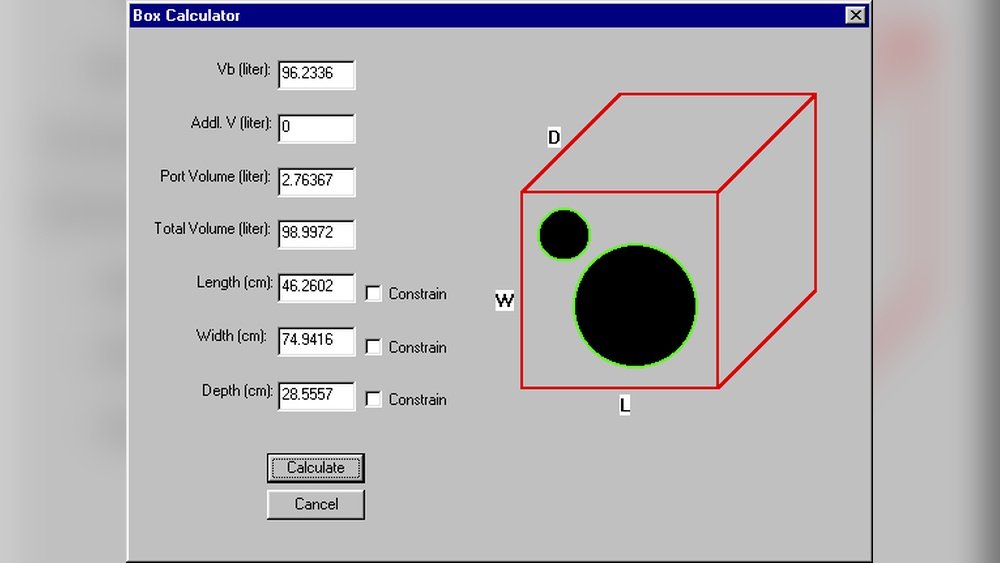
Optional: Subwoofer box design software can help, but is not required for basic builds.
Credit: subbox.pro
How To Calculate Subwoofer Box Volume: Step-by-step
Let’s break down the process into simple steps. We’ll focus on the most common box shape: a rectangular (box-shaped) enclosure.
1. Find The Recommended Volume
Start with the manufacturer’s recommendation. For example, a 12-inch subwoofer might need 1.25 cubic feet (net volume) for a sealed box.
2. Decide On Box Shape And Dimensions
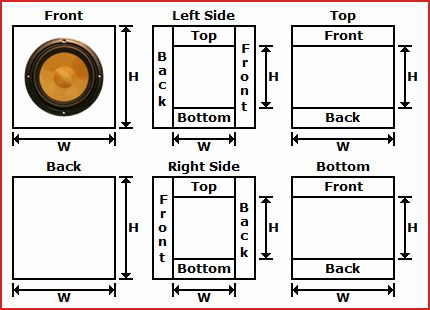
Most DIY sub boxes are rectangles, but you can use any shape as long as you know how to measure it.
- Measure internal dimensions (length, width, height) in inches.
- Don’t include the material thickness in your measurements.
3. Calculate Internal Volume
Use this simple formula for a rectangle:
- Volume (cubic inches) = Length × Width × Height
Example:
- Length = 20 inches
- Width = 14 inches
- Height = 12 inches
- 20 × 14 × 12 = 3,360 cubic inches
4. Convert To Cubic Feet
There are 1,728 cubic inches in a cubic foot.
- Volume (cubic feet) = Volume (cubic inches) ÷ 1,728
From our example:
- 3,360 ÷ 1,728 = 1.94 cubic feet
5. Subtract Subwoofer And Port Displacement
- Check your subwoofer specs for displacement (often 0.10–0.20 cubic feet).
- If you have a port, add its displacement too.
Example:
- Subwoofer displacement = 0.12 cu ft
- Port displacement = 0.05 cu ft
- Net volume = 1.94 – 0.12 – 0.05 = 1.77 cu ft
6. Adjust Dimensions As Needed
If your net volume is too high or low, adjust the box size and recalculate until you match the recommended value.
7. Double-check Everything
- Measure twice, cut once!
- It’s easy to make mistakes with decimals, so check your math.
Example Calculation
Let’s walk through a real example for a beginner:
- Subwoofer: 12-inch, sealed box recommended at 1.25 cu ft (net)
- Subwoofer displacement: 0.10 cu ft
- Box material: 0.75-inch thick MDF
Step 1: Pick Internal Box Dimensions That Add Up To About 1.35 Cu Ft Gross (so Net Is Close To 1.25 After Displacement).
- Guess: 16″ (L) x 13″ (W) x 14″ (H)
- 16 × 13 × 14 = 2,912 cubic inches
- 2,912 ÷ 1,728 = 1.685 cu ft (gross)
Step 2: Subtract Displacement
- 1.685 – 0.10 = 1.585 cu ft (net)
Step 3: Adjust
- Slightly reduce one dimension. Try 14″ (L):
- 14 × 13 × 14 = 2,548
- 2,548 ÷ 1,728 = 1.475 cu ft
- 1.475 – 0.10 = 1.375 cu ft (net)
Step 4: Final Adjustment
- Try 13″ (L):
- 13 × 13 × 14 = 2,366
- 2,366 ÷ 1,728 = 1.37 cu ft
- 1.37 – 0.10 = 1.27 cu ft (net) — now it’s close to 1.25 cu ft!
This approach gets you a box that matches the recommended volume.
How To Measure Irregular Shapes
Not all subwoofer boxes are simple rectangles. Sometimes, you need to fit the box in a trunk or under a seat, so it’s wedge-shaped or has angles.
- Divide the box into simple shapes (cubes, triangles, etc. ).
- Measure each part’s volume, then add them together.
For a wedge (trapezoidal box):
- Volume = Average Depth × Width × Height
Where Average Depth = (Top Depth + Bottom Depth) ÷ 2
Example For A Wedge Box
- Top depth = 6″
- Bottom depth = 12″
- Width = 20″
- Height = 14″
Average Depth = (6 + 12) ÷ 2 = 9″
- 9 × 20 × 14 = 2,520 cubic inches
- 2,520 ÷ 1,728 = 1.46 cu ft
Subtract displacement as before.
Table: Example Volumes For Box Sizes
Here is a quick reference for different box sizes (internal dimensions, all in inches):
| Length | Width | Height | Volume (cu ft) |
|---|---|---|---|
| 16 | 13 | 14 | 1.37 |
| 18 | 14 | 12 | 1.75 |
| 20 | 15 | 12 | 2.08 |
These numbers are before subtracting subwoofer/port displacement.
Table: Subwoofer Size Vs. Typical Box Volume
Different subwoofer sizes need different box volumes. Here’s a basic comparison:
| Subwoofer Size | Sealed Box Volume (cu ft) | Ported Box Volume (cu ft) |
|---|---|---|
| 8-inch | 0.5–0.8 | 0.7–1.0 |
| 10-inch | 0.7–1.0 | 1.0–1.5 |
| 12-inch | 1.0–1.5 | 1.5–2.5 |
| 15-inch | 2.0–3.0 | 3.0–5.0 |
Always check the actual subwoofer’s manual for the right number.
Common Mistakes And How To Avoid Them
Beginners often make a few key mistakes when building subwoofer boxes. Here’s how to avoid them:
- Ignoring material thickness: Always measure inside dimensions for air space.
- Forgetting displacement: Sub and port take up space—subtract their volume.
- Overestimating box volume: Bigger isn’t always better. Follow the specs.
- Poor sealing: Air leaks ruin bass. Use silicone or foam tape for airtight seals.
- Not checking fit: Measure your trunk or space before building!
Practical Tips For Better Results
- Use box design calculators online for fast planning.
- Double-check math before cutting wood.
- Bracing: For large boxes, add wooden braces inside to stop vibration.
- Carpet or paint: Helps seal the box and looks better.
- Test fit all parts before gluing.
Non-obvious Insights Beginners Miss
- Box shape affects sound: A box that’s too shallow or oddly shaped can cause standing waves or unwanted peaks. Try to keep at least one dimension different from the others.
- Adding stuffing (polyfill): Adding polyester fiber inside the box can “trick” the subwoofer into acting like it’s in a slightly larger box (up to 20% more). This is useful if your box is a bit too small.
When To Use Subwoofer Box Calculators
Online calculators and phone apps are great for checking your work or planning more complex boxes. They can handle:
- Irregular shapes
- Multiple subwoofers
- Ported and bandpass designs
But it’s still important to understand the basic math, so you can double-check the numbers.
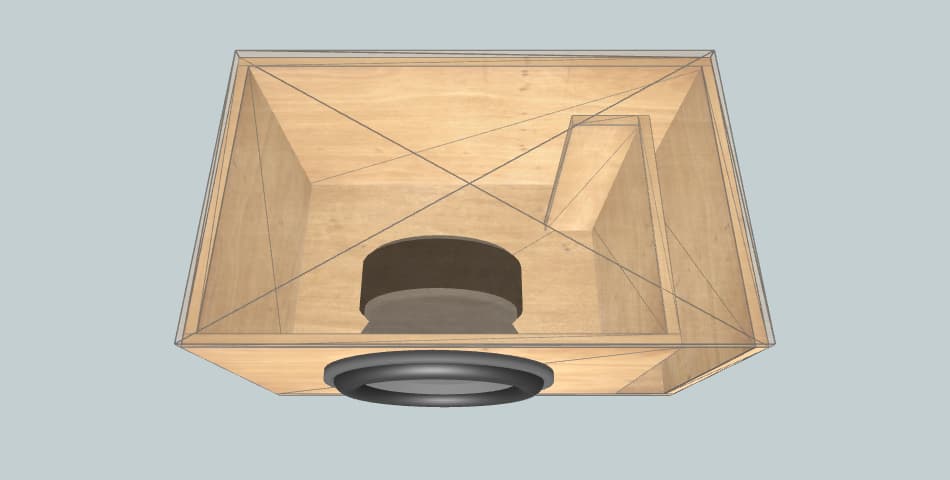
Advanced: Calculating For Ported Boxes
If you want to build a ported box, you need to account for the port’s size and length. The port also takes up air space, so subtract it from your gross box volume.
- Most manufacturers provide port size and length for the recommended box.
- If not, use an online calculator to design the port correctly.
Credit: www.diyaudioandvideo.com
Table: Box Volume Conversion Reference
Quick conversions for common measurements:
| Cubic Inches | Cubic Feet | Liters |
|---|---|---|
| 1,728 | 1 | 28.32 |
| 3,456 | 2 | 56.64 |
| 5,184 | 3 | 84.96 |
This makes it simple to convert between different units.
Frequently Asked Questions
How Do I Know What Box Volume My Subwoofer Needs?
Check your subwoofer’s manual or the manufacturer’s website. They give the recommended box volume for sealed, ported, and bandpass boxes. Never guess—always follow these specs for best results.
Can I Use A Bigger Or Smaller Box Than Recommended?
Going a little bigger or smaller is possible, but the sound will change. Too small gives tight but weak bass. Too big makes bass loose and can damage the sub. Stay within 10% of the recommended volume for best performance.
How Do I Measure Box Volume If My Box Has An Odd Shape?
Break the shape into simple parts—rectangles, triangles, wedges. Measure each part, calculate their volumes, then add together. Always use internal dimensions for accurate air space.
Do I Need To Subtract The Subwoofer And Port Displacement From The Box Volume?
Yes. The subwoofer and port take up space inside the box. Always subtract their displacement from the gross box volume to get the net volume—this is the number you match to the manufacturer’s specs.
Are There Online Tools To Help With Subwoofer Box Calculations?
Yes. Many websites and apps offer calculators for subwoofer boxes. These tools can make planning faster and reduce mistakes. For more information, visit Crutchfield’s subwoofer box guide.
Getting your subwoofer box volume right is the foundation of deep, clean bass. By following these steps, using practical examples, and paying attention to details, you’ll enjoy much better sound from your system—without wasting time or money. Double-check your math, use the manufacturer’s specs, and remember: the right box volume turns good bass into great bass!
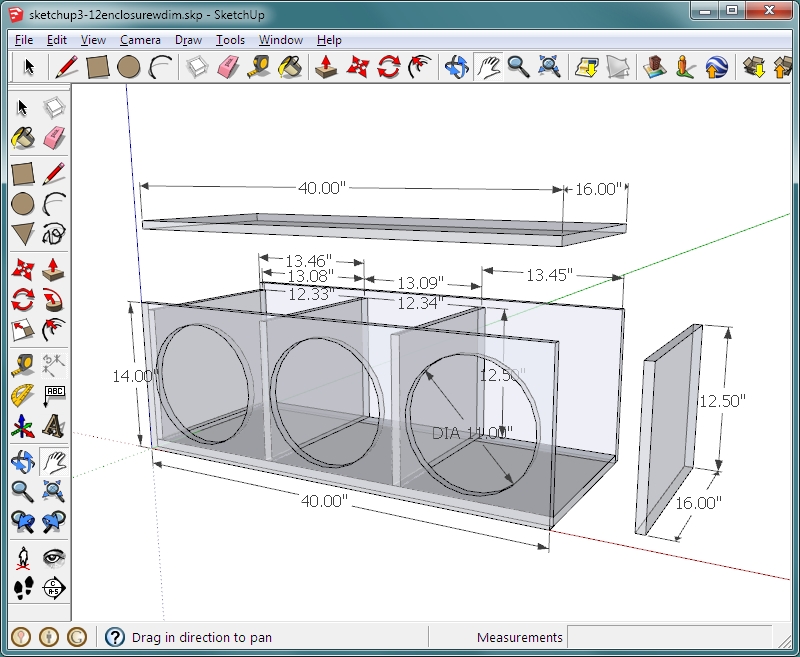
Credit: www.bcae1.com