Half Bridge Vs Full Bridge: Key Differences Explained
Half Bridge Vs Full Bridge: Beginner-friendly Guide
If you are learning about power electronics, you will quickly see the terms half bridge and full bridge. These two circuit types are used everywhere from motor drives to power supplies. But what do they mean? How are they different? And which one is better for your project? This article explains half bridge vs full bridge in simple words, with examples and real-world data. Whether you are a student or a hobbyist, you will understand the basics and the practical differences by the end.
What Is A Bridge Circuit?
A bridge circuit is a setup of electronic switches or transistors that allows current to flow through a load in different ways. It is called a bridge because the arrangement often looks like a bridge on a circuit diagram.
Bridge circuits are common in:
- DC-AC inverters
- DC motor drivers
- Power amplifiers
- Switch-mode power supplies
The main job is to control voltage and current direction across a load, like a motor or a resistor.
Understanding The Half Bridge
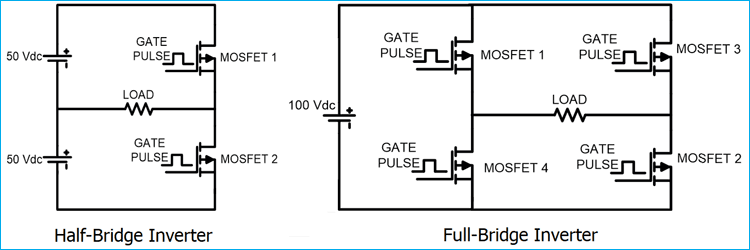
A half bridge uses two electronic switches (like MOSFETs or IGBTs) and two capacitors. It connects the load between the middle point of the switches and ground.
Basic working:
- When the top switch turns on, current flows through the load in one direction.
- When the bottom switch turns on, current flows in the opposite direction.
- Only one switch is ON at a time.
Key features:
- Simple design
- Uses fewer components
- Lower cost
Where it’s used:
- Small motor controllers
- Simple DC-DC converters
- Low-power inverters
Example: Simple Led Flasher
Imagine using a half bridge to make an LED blink. When the top switch is ON, the LED lights up. When the bottom switch is ON, the LED turns off. This is a simple example, but the same principle is used in more complex devices.

Credit: www.researchgate.net
Understanding The Full Bridge
A full bridge (also called H-bridge) uses four switches. The load is connected between the two center points of the bridge.
How it works:
- Two switches on opposite sides turn ON at the same time.
- This lets current flow across the load in both directions.
- You can control not just ON/OFF but also direction of current.
Key features:
- Can reverse the current
- More control (speed and direction for motors)
- Handles higher power
Where it’s used:
- DC motor drivers (robotics, drones)
- High-power inverters
- Audio power amplifiers
Example: Electric Car Motor
Full bridges are used to drive electric car motors. The driver can reverse the car by changing the direction of current with the full bridge. Without a full bridge, reversing would need extra mechanical parts.
Key Differences: Half Bridge Vs Full Bridge
The best way to see the difference is to compare side by side. Here’s a simple look:
| Feature | Half Bridge | Full Bridge |
|---|---|---|
| Number of Switches | 2 | 4 |
| Direction Control | One-way | Two-way |
| Voltage Across Load | Half of supply | Full supply voltage |
| Complexity | Simple | More complex |
| Cost | Lower | Higher |
Circuit Diagrams
Below are simple diagrams to show the connections. (In practice, use proper circuit symbols. )
Half Bridge:
- Two switches (Q1, Q2)
- Load connected between middle point and ground
Full Bridge:
- Four switches (Q1, Q2, Q3, Q4)
- Load connected between the two center points
This arrangement in the full bridge lets you send current both ways.
Applications In Real Life
Half Bridge In Power Supplies
Half bridge circuits are widely used in switch-mode power supplies for computers and TVs. They are chosen for:
- Medium power (100W–500W)
- Cost-effective design
For example, a 250W computer power supply often uses a half bridge because it is efficient and simple.
Full Bridge In Motor Drives
Modern electric wheelchairs use a full bridge to drive motors. This allows the chair to move forward and backward smoothly. The full bridge controls speed and direction with the same circuit.
Data Example: Inverter Output
Here’s a comparison of inverter output using half bridge and full bridge at 24V input:
| Type | Maximum Output Voltage | Output Current | Efficiency (%) |
|---|---|---|---|
| Half Bridge | 12V RMS | Up to 10A | 85–90 |
| Full Bridge | 24V RMS | Up to 20A | 90–95 |
As you can see, the full bridge can give higher output voltage and current.
Advantages And Disadvantages
Half Bridge: Pros And Cons
Advantages:
- Fewer parts (easier to build)
- Lower cost
- Less heat generated
Disadvantages:
- Only half the supply voltage across the load
- Cannot reverse current direction
- Less suitable for high-power needs
Full Bridge: Pros And Cons
Advantages:
- Full supply voltage across the load
- Can reverse current direction
- Good for high power
Disadvantages:
- More parts (harder to build)
- Higher cost
- More complex control
Choosing Between Half Bridge And Full Bridge
When should you pick a half bridge, and when a full bridge? Here is a simple decision guide.
- Use half bridge if:
- You need a simple, cheap solution
- Only one-way current is needed
- Power level is not very high
- Use full bridge if:
- You want to reverse current (e.g., for a motor)
- High power or higher voltage is required
- Accurate control is important
Real-world Example: Home Appliance Motors
Washing machines often use full bridges to control the drum motor. The drum must spin in both directions, so the full bridge is perfect. In contrast, a simple fan might use a half bridge, because the motor only needs to spin one way.
Credit: www.bequiet.com
Common Mistakes Beginners Make
- Confusing Direction Control: Some think half bridges can reverse current. They cannot. Only full bridges can do this.
- Underestimating Heat: Full bridge circuits can get hot if not designed well. Always plan for cooling.
- Ignoring Power Ratings: Using a half bridge for high-power motors can damage components.
- Wrong Switching: Turning on the wrong pair of switches in a full bridge can cause a short circuit. Use proper logic to control them.
Practical Tips For Designing Bridge Circuits
- Use MOSFETs for efficient switching, especially at high frequencies.
- Add flyback diodes to protect switches from voltage spikes.
- Check the datasheets for maximum voltage and current.
- Always test with a small load first, then increase.
When To Use Half Bridge Vs Full Bridge: Case Study
Let’s say you are building a small robot. The motors are 6V, and you want the robot to move forward and backward. You need to:
- Reverse motor direction (full bridge)
- Control speed (pulse-width modulation, PWM)
If you only want the robot to move forward, a half bridge is enough.
But for most robots, full bridge is the right choice.
Recent Developments
Modern integrated circuits (ICs) now offer both half bridge and full bridge drivers in a single chip. This makes it easier to build compact and reliable devices. For example, the L298 IC is a full bridge driver used in many robotics kits.
Some manufacturers use GaN (gallium nitride) transistors for higher efficiency. These are found in the latest power supplies and electric vehicles.
Credit: circuitdigest.com
Cost Comparison
Here’s a rough cost breakdown for a 24V, 10A circuit (prices may vary):
| Component | Half Bridge | Full Bridge |
|---|---|---|
| Switches (MOSFETs) | 2 × $1.50 = $3 | 4 × $1.50 = $6 |
| Driver IC | $2 | $3 |
| Passive Parts | $1 | $2 |
| Total | $6 | $11 |
A full bridge costs more, but gives you more features and power.
Summary Table: When To Use Each
| Scenario | Recommended Bridge | Reason |
|---|---|---|
| One-way motor drive | Half Bridge | Simple, low cost |
| Bidirectional motor drive | Full Bridge | Control direction |
| High power inverter | Full Bridge | Full voltage output |
| Audio amplifier | Full Bridge | Better sound power |
| Simple LED driver | Half Bridge | Low cost, easy |
Frequently Asked Questions
What Is The Main Difference Between A Half Bridge And A Full Bridge?
The main difference is the number of switches and the ability to control current direction. A half bridge uses 2 switches and can only control current in one direction, while a full bridge uses 4 switches and can reverse the current.
Why Does A Full Bridge Give Higher Output Voltage?
A full bridge can apply the full supply voltage across the load, while a half bridge can only apply half the supply voltage. This is because of the way the switches are arranged.
Is A Half Bridge Always Cheaper Than A Full Bridge?
Usually yes, because it uses fewer parts. But the exact cost depends on the components and power level. For small projects, the difference may be small.
Can I Use A Half Bridge To Drive A Motor In Both Directions?
No. You need a full bridge to reverse the current and change motor direction. A half bridge can only run the motor in one way.
Where Can I Learn More About Bridge Circuits?
A good place to start is the H-Bridge Wikipedia page, which covers history, applications, and advanced topics.
In summary, choosing between half bridge and full bridge depends on your project’s needs. If you need simple, low-cost control, go for a half bridge. If you need more power and direction control, use a full bridge. Always check your requirements and design safely.
With these basics, you are ready to start building or troubleshooting bridge circuits.