Can You Wire SVC and DVC Subs on Same Amplifier? Explained
Can You Wire Svc And Dvc Subs On Same Amplifier?
Upgrading your car or home audio can be exciting—but it gets confusing quickly, especially when dealing with SVC (Single Voice Coil) and DVC (Dual Voice Coil) subwoofers. Many beginners ask: *Can you connect both SVC and DVC subs to the same amplifier?* The answer isn’t a simple yes or no. It depends on wiring, impedance, and your amplifier’s limits.
Let’s break down everything you need to know so you can wire your subs safely and get the best sound for your system—without damaging your gear.
Understanding Svc And Dvc Subwoofers
Before wiring, you need to understand what makes SVC and DVC subs different.
- SVC (Single Voice Coil): Has one set of terminals (positive and negative). It’s simple to connect.
- DVC (Dual Voice Coil): Has two sets of terminals. You can wire it for different impedances (usually 2 ohms or 4 ohms).
Key advantage: DVC subs offer more wiring options, which helps you match the sub’s impedance to your amplifier’s safe operating range.
Why Does Coil Type Matter?
The type of sub affects:
- Wiring flexibility
- Total impedance (load seen by amplifier)
- Power distribution
Mixing SVC and DVC can make wiring complex. If not done right, you might:
- Overload your amp (cause overheating or failure)
- Run subs below their rated power (weak bass)
- Damage your equipment
Can You Wire Svc And Dvc Subs On Same Amplifier?
The short answer: Yes, you can—but it’s tricky and requires careful planning.
Mixing SVC and DVC subs is possible if:
- The final load impedance matches the amplifier’s safe range
- Each sub receives power within its rated limits
- Wiring is done correctly to avoid phase or polarity issues
Important: Never guess the wiring. Always calculate total impedance and check your amp’s manual.
How Subwoofer Impedance Works
Impedance (measured in ohms, Ω) is the resistance a sub gives to the amplifier’s signal. Matching your amp’s stable impedance range is crucial.
- Most amps support 2Ω or 4Ω loads per channel.
- Too low an impedance can overheat or damage the amp.
- Too high means less power and weaker bass.
Example: Typical Subwoofer Impedances
- SVC sub: 4Ω or 2Ω
- DVC sub: 4Ω (each coil), wired as 2Ω (parallel) or 8Ω (series)
Common Wiring Scenarios
Let’s look at how SVC and DVC wiring works in practice.
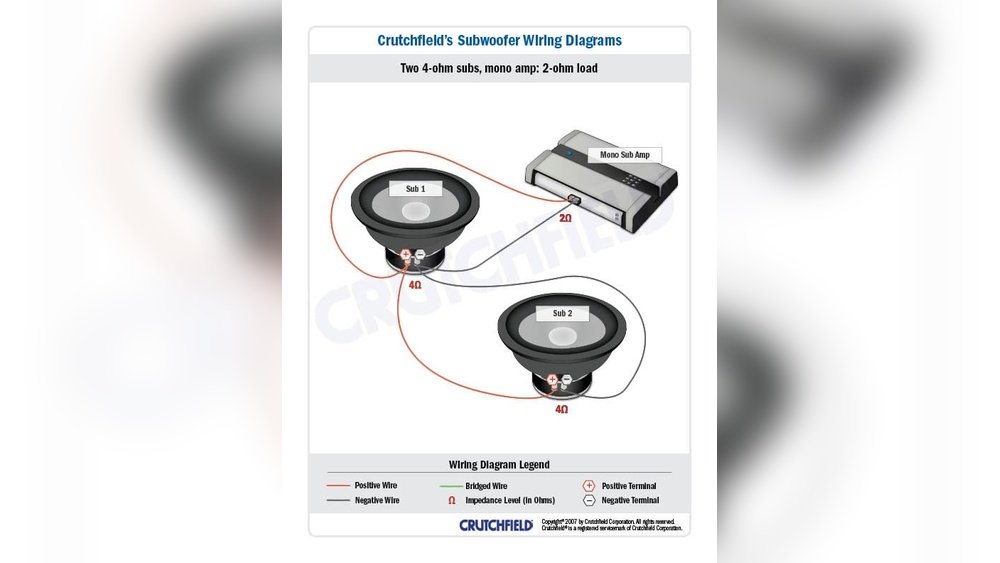
1. Two Svc 4ω Subs In Parallel
- Each sub: 4Ω
- Wired in parallel: 2Ω total load
2. One Dvc 4ω Sub Wired In Parallel
- Each coil: 4Ω
- Wired in parallel: 2Ω total load
3. One Svc 4ω And One Dvc 4ω (wired In Parallel)
- SVC: 4Ω
- DVC (parallel wiring): 2Ω
- Total load: (1 / (1/4 + 1/2)) = 1.33Ω
Problem: 1.33Ω is too low for most amps—risk of overheating.
Solution: Wire DVC in series (8Ω), then parallel with SVC (4Ω):
- SVC 4Ω + DVC 8Ω (parallel): (1 / (1/4 + 1/8)) = 2.67Ω
Now, this is safe for most 2Ω-stable amps.
Practical Example: Mixing Svc And Dvc Subs
Suppose you have:
- One SVC 4Ω sub
- One DVC 4Ω sub
Goal: Connect both to a mono amplifier that supports 2Ω loads.
Step-by-step Wiring
- Wire the DVC sub in series: Connect one coil’s positive to the amp’s positive, the other coil’s negative to the amp’s negative, and the coil’s negative to the other coil’s positive.
- DVC sub now has 8Ω total.
- Wire the SVC and DVC (now 8Ω) in parallel: Connect positives together to the amp’s positive, negatives together to the amp’s negative.
- Total load: 4Ω (SVC) + 8Ω (DVC in series) = 2.67Ω (parallel formula).
Your amp will see a 2.67Ω load, which is safe if it’s rated for 2Ω or higher.
Wiring Methods: Series Vs Parallel
How you wire subs greatly affects the load on your amp.
Series Wiring
- Increases impedance
- Safest for amps with higher minimum load
Wiring: Positive of sub A to amp’s positive, negative of sub A to positive of sub B, negative of sub B to amp’s negative.
Parallel Wiring
- Lowers impedance
- Gives more power per sub, but risks amp overload
Wiring: All positives together to amp’s positive, all negatives together to amp’s negative.
Comparing Series And Parallel
Here’s a quick comparison:
| Wiring Type | Impedance Effect | Power to Subs | Risk |
|---|---|---|---|
| Series | Increases | Less | Very low |
| Parallel | Decreases | More | High if too low impedance |
Key Factors When Mixing Svc And Dvc Subs
1. Impedance Matching
- Always calculate the final load impedance
- Never drop below your amp’s minimum rating
2. Power Distribution
- Amplifier power divides among subs
- If subs have different impedances, power splits unevenly
- Lower-impedance sub may get more power, causing imbalance
3. Phase And Polarity
- All subs must be wired in phase (positives and negatives matched)
- Out-of-phase wiring weakens bass
4. Subwoofer Ratings
- Both subs must handle the amp’s power output
- Don’t overpower a lower-rated sub
Real-world Example: Power And Impedance
Imagine you have an amp that delivers 500W RMS at 2Ω.
- SVC 4Ω sub: Handles 250W RMS
- DVC 4Ω sub: Handles 250W RMS
If you wire them for a 2.67Ω load, the amp gives slightly less than 500W (maybe 420W). Power divides unevenly:
- SVC 4Ω gets more power than DVC 8Ω (in parallel)
- Use an online calculator or amp manual to estimate exact split
Insight: You may not get full power from your amp, and one sub could play louder than the other.

Credit: www.nilds.gov.ng
What If You Mix Different Sub Sizes Or Brands?
Mixing different brands, sizes, or models (not just coil types) is possible, but not ideal.
- Sound quality may suffer (uneven response, weird bass effects)
- Matching impedance and power handling is still required
- Tuning the system gets harder
For best results, use identical subs. If mixing is necessary, stick to similar power ratings and sensitivities.
Best Practices For Wiring Svc And Dvc Subs Together
- Calculate final impedance before connecting anything.
- Check amp ratings—never go below the minimum stable impedance.
- Use high-quality speaker wire to handle the power.
- Wire all subs in phase for clean bass.
- Test the system at low volume first to catch any problems.
- If possible, use a multimeter to verify total resistance before powering up.
Common Mistakes Beginners Make
- Ignoring final impedance—risking amp damage.
- Mixing subs with very different power ratings—one sub may distort or fail.
- Wiring out of phase—causing weak or muddy bass.
- Forgetting to check the amp’s manual for safe wiring guidelines.
Non-obvious tip: Some amplifiers have built-in protection and will shut down if the impedance is too low. Don’t count on this—it’s not a substitute for correct wiring!
Example Wiring Diagrams
Let’s visualize two common scenarios.
Example 1: Svc 4ω + Dvc 4ω (dvc In Series)
- DVC sub: Wire both coils in series (8Ω)
- SVC sub: 4Ω
- Both subs in parallel: Amp sees 2.67Ω
Example 2: Svc 2ω + Dvc 4ω (dvc In Parallel)
- DVC sub: Wire coils in parallel (2Ω)
- SVC sub: 2Ω
- Both subs in parallel: (1 / (1/2 + 1/2)) = 1Ω (too low for most amps!)
Result: Most mono amps can’t handle 1Ω. You must wire differently or use another amp.
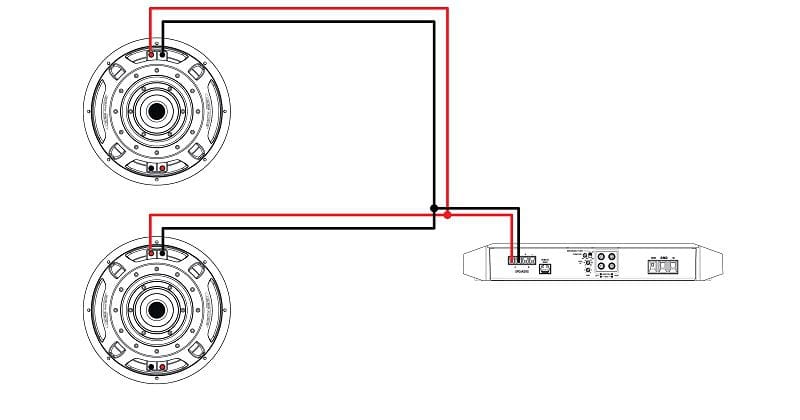
Credit: www.bestcaraudio.com
Comparing Svc And Dvc Sub Wiring Flexibility
Here’s a quick look:
| Subwoofer Type | Wiring Options | Best Use |
|---|---|---|
| SVC | Single (per sub) | Simple systems |
| DVC | Series or Parallel (per sub) | Flexible, custom setups |
| SVC + DVC | Limited (must calculate impedance) | When matching subs isn’t possible |
Is It Worth Mixing Svc And Dvc Subs?
If you already own both types, mixing them can save money. But it’s not the most efficient or best-sounding setup.
Pros:
- Use existing equipment
- Possible to match amp’s load with careful wiring
Cons:
- More complex wiring
- Potential imbalance in sound output
- Harder to upgrade or expand system later
If you want the best bass and easiest wiring, use all SVC or all DVC subs.
Credit: rockfordfosgate.zendesk.com
When To Avoid Mixing Svc And Dvc Subs
- If you want maximum performance and cleanest bass
- If you’re using a high-powered or competition system
- If you’re unsure about wiring or calculations
Sticking to one coil type reduces mistakes and makes future upgrades smoother.
Troubleshooting Common Issues
No Sound From Subs
- Check all wiring
- Verify amp is on and not in protection mode
Weak Or Distorted Bass
- Check phase—are all sub positives and negatives matched?
- Ensure amp isn’t overloaded (check for hot amp or flashing protect light)
Amp Shuts Down
- Impedance may be too low—rewire for higher load
- Check for short circuits in wiring
Insight: Most issues come from wiring mistakes, not faulty equipment.
Recommended Tools For Safe Wiring
- Digital multimeter: Check impedance and continuity
- Quality speaker wire: At least 12 gauge for subwoofers
- Screwdrivers, wire strippers, electrical tape
Don’t skip these tools—guesswork causes expensive mistakes.
External Reference
For a detailed explanation of subwoofer wiring diagrams and load calculations, see this Crutchfield guide.
Frequently Asked Questions
Can I Wire Svc And Dvc Subs To The Same Amp Channel?
Yes, but you must match the final impedance to your amp’s rating and wire all subs in phase. Always check total resistance before connecting.
Will Mixing Svc And Dvc Subs Affect Sound Quality?
It can. Different coil types may have uneven power handling, causing one sub to play louder. For best sound, use matched subs.
Is It Safe To Mix Different Subwoofer Sizes Or Brands?
It’s possible, but not ideal. Different sizes or brands may have different sensitivities and tones, making tuning difficult.
What Happens If My Final Impedance Is Too Low?
Your amp may overheat, shut down, or get damaged. Always wire for an impedance at or above your amp’s minimum rating.
How Do I Calculate Total Impedance With Svc And Dvc Subs?
- Wire DVC coils first (series or parallel)
- Calculate each sub’s impedance
- Use the parallel formula for total load: 1 / (1/A + 1/B + …)
- Double-check against your amp’s manual
Wiring SVC and DVC subs on the same amplifier is possible with careful planning and calculation. If you want simple, reliable bass, use matching subs. If you must mix, take your time, check all wiring, and enjoy your music with confidence.