How to Connect Subwoofer to Car Stereo Without Amp Easily
Many car owners love a deep, punchy bass in their music, but not everyone wants to install an amplifier. You may have a tight budget, limited space, or simply want a simpler setup. Is it possible to connect a subwoofer to a car stereo without an amp? The answer is yes, but you need to know the right steps, tools, and what to expect. This guide will show you how to get more bass from your car stereo safely and effectively—without adding an external amplifier.
Can You Connect A Subwoofer Without An Amp?
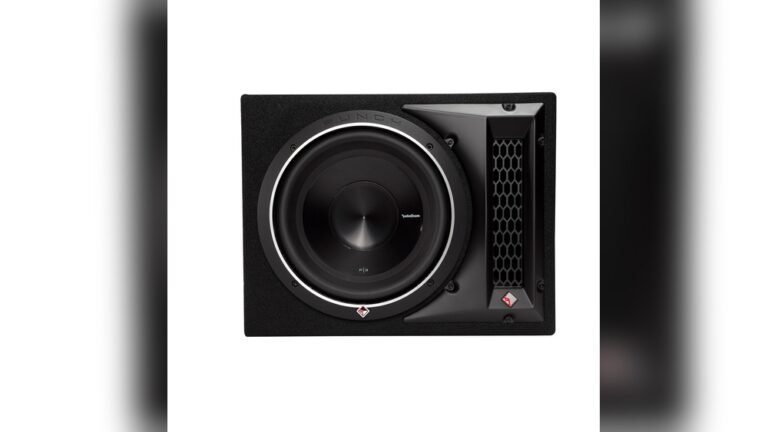
Most car audio setups use an amp to power the subwoofer. Amps provide the strong electrical signal needed for deep bass. However, some subwoofers are designed with built-in amplifiers (called powered subwoofers) or can work with lower-power outputs from the car stereo.
Key facts:
- A passive subwoofer (no built-in amp) almost always needs an external amplifier.
- A powered subwoofer can often connect directly to your car stereo.
- Direct connection works best if your subwoofer is low-power and your stereo has subwoofer outputs or strong speaker outputs.
If you want loud, window-shaking bass, you’ll need an amp. But for more subtle bass improvement, you can try connecting without one.
What You Need Before You Start
You will need some basic tools and knowledge to get started. Here’s a checklist:
- Powered subwoofer (or a passive sub rated for low power)
- Speaker wire
- Wire strippers/cutters
- Electrical tape or wire connectors
- Car stereo with speaker-level outputs (most stock stereos have these)
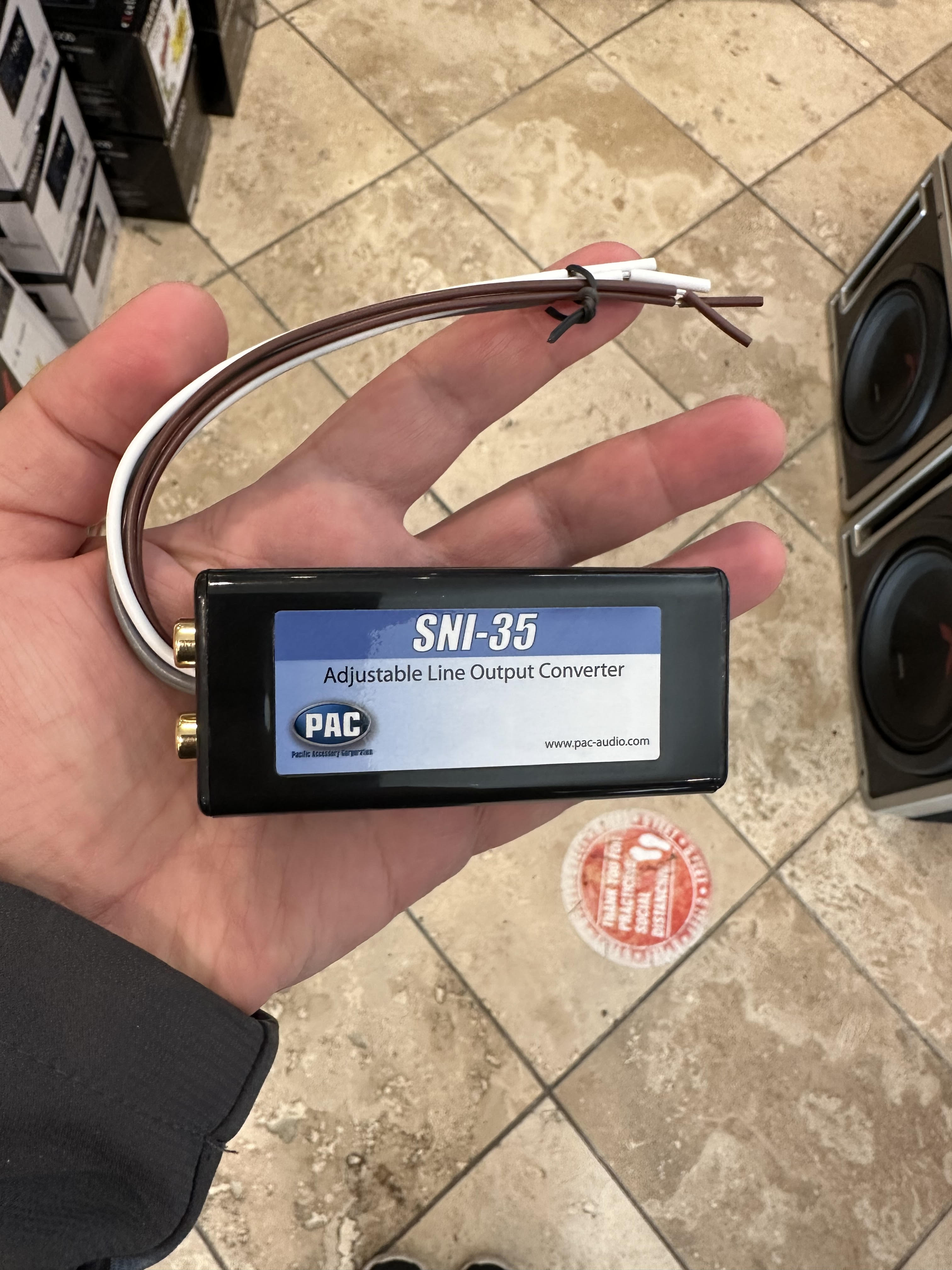
- Optional: Line output converter (LOC) if your subwoofer has RCA input only
Important: Always check your car’s manual and subwoofer specs before you begin. Not all setups are safe for direct connection.

Credit: soundcertified.com
Step-by-step: Connecting Subwoofer To Car Stereo Without Amp
Let’s break down the process into easy steps. This method works best for powered subwoofers or small passive subs.
1. Locate Your Stereo’s Speaker Wires
Find the wires that send audio from your car stereo to the speakers. Usually, these are behind the stereo unit or under the dashboard.
- Use your car manual or look up a wiring diagram for your car model.
- Common wire colors: White/gray (front speakers), green/purple (rear speakers).
2. Identify The Subwoofer Input Type
Check your subwoofer’s input:
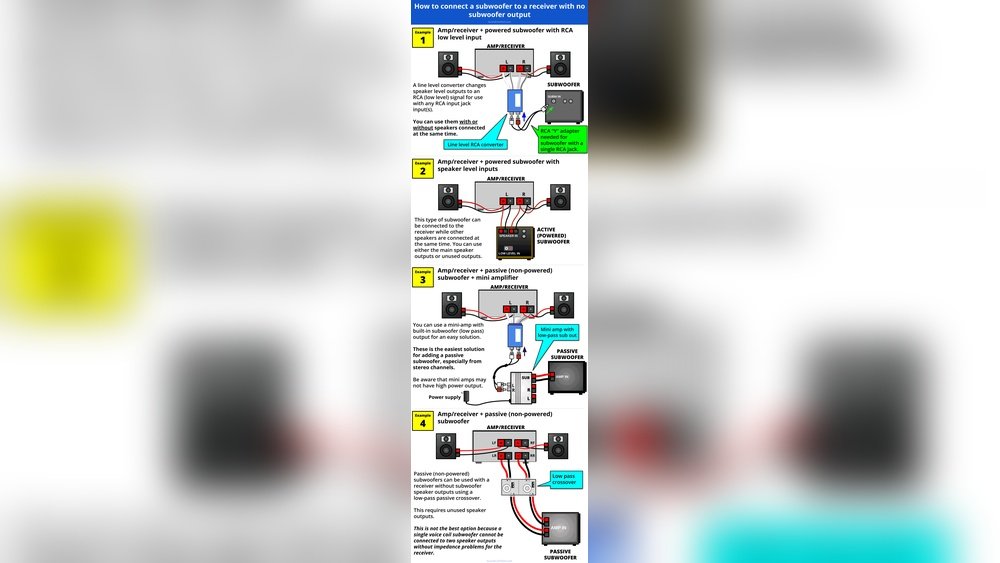
- High-level (speaker) input: Accepts bare speaker wires directly.
- Low-level (RCA) input: Needs an RCA plug, which is usually for amps.
If your subwoofer only has RCA input, you’ll need a line output converter (LOC) to change the speaker wire signal to RCA.
3. Connect Speaker Wires To Subwoofer
- Turn off your car and disconnect the battery for safety.
- Strip a small section of insulation off the speaker wires (usually rear speakers are best).
- Attach speaker wires from the stereo to the high-level input on the subwoofer.
- Make sure to match positive (+) and negative (−) connections.
Example wiring:
- Left rear speaker (+) → Subwoofer input (+)
- Left rear speaker (−) → Subwoofer input (−)
Use connectors or twist and tape wires securely.
4. Power The Subwoofer
If you have a powered subwoofer, it needs a power connection.
- Find a 12V power source (usually from the car’s fuse box or directly from the battery).
- Connect the ground wire to a bare metal part of your car body.
- Attach the remote turn-on wire to a source that turns on with the stereo (like the accessory wire).
Tip: Use a fuse in the power wire for safety.
5. Test Your Subwoofer
- Reconnect the car battery.
- Turn on your stereo and play some bass-heavy music.
- Adjust the subwoofer gain and crossover controls for best sound.
If you hear clean bass and your speakers are working, you’ve done it right.
Example: Connecting A Powered Subwoofer
Let’s say you have a JBL BassPro SL2 powered subwoofer and a basic car stereo.
- Locate rear speaker wires behind the stereo.
- Use speaker wire to connect the left and right rear outputs to the sub’s speaker-level input.
- Run a fused power wire from the battery to the sub.
- Ground the sub to the car chassis.
- Use the stereo’s accessory wire for the remote turn-on.
- Test and adjust settings.
This setup typically takes 30–60 minutes and adds deeper bass to most factory stereos.
What To Expect: Sound Quality And Bass Levels
Connecting a subwoofer without an amp will not give you competition-level bass. But it can make a big difference in your music’s depth and punch.
Typical results:
- Improved low-end sound (noticeable bass)
- Cleaner separation between bass and main speakers
- Less distortion at moderate volume
Limitations:
- Max volume and bass will be lower than with an amp
- Risk of distortion if you turn up the bass too high
- Not suitable for very large or passive subwoofers
Data Comparison: Bass Output
Here’s a simple comparison of bass output with and without an amp:
| Setup Type | Peak Bass Output (dB) | Sound Quality |
|---|---|---|
| Stereo Only (No Sub) | 90–95 dB | Weak bass, thin sound |
| Stereo + Sub (No Amp) | 95–100 dB | Noticeable bass boost |
| Stereo + Sub + Amp | 105–115 dB | Deep, powerful bass |
For most casual listeners, the middle setup is a strong upgrade.
Pros And Cons Of Skipping The Amp
Is it worth connecting a subwoofer without an amp? Here are the main points:
| Pros | Cons |
|---|---|
| – Simple installation – Lower cost – Less space needed – Fewer cables |
– Lower bass volume – Possible distortion – Limited subwoofer choices – Not for bass enthusiasts |
For many, simplicity and cost make this setup attractive.
Choosing The Right Subwoofer For No-amp Setup
Not all subwoofers will work well without an amp. Here’s what to look for:
- Powered subwoofer: Has a built-in amp, easy to connect.
- Low-power passive subwoofer: 50–150W RMS can sometimes work, but results are limited.
- High-sensitivity rating: 90 dB or higher for better performance at low power.
- High-level (speaker) input: Lets you connect directly to speaker wires.
Common mistake: Trying to use a large, high-power subwoofer without an amp. This often leads to poor sound or even damage.
Practical tip: Check the subwoofer’s owner’s manual to see if direct connection is supported.
Wiring Methods: High-level Vs Low-level Input
There are two main ways to connect a subwoofer to your car stereo:
High-level (speaker Wire) Input
- Most stock stereos only have speaker outputs.
- Subwoofer with high-level input accepts these signals.
- Simple, reliable, no extra adapters needed.
Low-level (rca) Input With Loc
- Needed if your sub only has RCA input.
- Use a line output converter (LOC) to turn speaker wires into RCA.
- Slightly more wiring, but gives a cleaner signal.
Example LOCs: PAC SNI-35, Scosche LOC2SL
Credit: www.sony.co.uk
Safety Tips And Common Mistakes
Installing car audio always requires attention to safety. Here’s how to avoid problems:
- Always disconnect the battery before wiring.
- Use the correct wire gauge (14–16 AWG is common for subwoofers).
- Do not overload speaker wires—using a sub that draws too much power can damage your stereo.
- Double-check polarity (+ and −) to avoid weak or distorted bass.
- Avoid pinching wires under seats or panels.
Beginner mistake: Forgetting to fuse the power wire. A short circuit can cause a fire.
When An Amp Is Still The Best Choice
For some users, skipping the amp is not the right call:
- If you want very loud bass
- If you have a large passive subwoofer (over 200W RMS)
- If your car stereo’s output is weak
In these cases, a small, compact amp may be a better solution. Some modern car amplifiers are tiny and fit under seats, making them almost as easy to install as a powered sub.
Cost Breakdown: No-amp Vs With-amp
How much can you save by skipping the amp? Here’s a typical cost comparison:
| Item | No-Amp Setup | With-Amp Setup |
|---|---|---|
| Powered Subwoofer | $100–$200 | $100–$200 |
| Wiring Kit | $20–$40 | $40–$60 |
| External Amp | — | $80–$200 |
| Total | $120–$240 | $220–$460 |
You can save $100–$200 and installation time by skipping the amp.
Troubleshooting: If You Don’t Hear Bass
If your subwoofer is not working, check these common issues:
- Loose wire connections: Re-tighten all wires.
- Blown fuse: Replace any blown fuses in your wiring.
- Wrong polarity: Swap the (+) and (−) speaker wires.
- No power: Check the power and ground connections.
- Settings: Make sure the subwoofer gain and crossover are set correctly.
Often, a simple fix is all you need.
Credit: hi-techcaraudio.com
Practical Tips For Better Results
- Use quality speaker wire to reduce power loss.
- Mount the subwoofer securely to avoid rattles.
- Don’t set the bass too high—this can stress your stereo and speakers.
- Keep wiring neat for easier troubleshooting.
- Check your car’s warranty—some modifications may void it.
When You Shouldn’t Skip The Amp
If you plan to upgrade your whole system or want bass you can feel, save for an amp. It’s still the most effective way to power a subwoofer.
External Resource
For more technical details on car audio wiring, see this car audio overview.
Frequently Asked Questions
Can I Connect Any Subwoofer To My Car Stereo Without An Amp?
No, only powered subwoofers or small, high-sensitivity passive subwoofers can work well without an amp. Large or high-power subs need an external amplifier for safe and strong performance.
Will My Car Stereo Be Damaged By Adding A Subwoofer Without An Amp?
If you use a subwoofer that draws too much power, you can overload your stereo’s output. Always check the subwoofer’s power rating and use high-level inputs when possible.
How Much Bass Can I Expect From A No-amp Setup?
You’ll get a noticeable bass boost but not as much as with an amp. Expect cleaner, fuller bass at moderate volumes. If you want deep, powerful bass, an amp is still necessary.
Do I Need A Line Output Converter?
Only if your subwoofer has RCA (low-level) inputs and your stereo does not. Most powered subs accept speaker-level inputs directly, so a converter isn’t always needed.
Is It Worth Adding A Subwoofer Without An Amp?
For most casual music listeners, yes. You get improved bass with less cost and easier installation. But if you want maximum bass or have a high-power sub, add an amp for best results.
Adding a subwoofer to your car stereo without an amp is a practical, budget-friendly way to improve your music. With the right gear and careful installation, you can enjoy deeper bass without a complicated setup. For most drivers, the difference is worth it—just stay within your stereo’s limits and enjoy the ride.