Wiring 2 Subs to Mono Amp: Ultimate Guide for Deep Bass
Wiring 2 Subs To Mono Amp: Beginner’s Guide
Want to add deep bass to your car or home audio? Many people choose to wire two subwoofers to a mono amplifier for strong, clean sound. But wiring subs isn’t just about connecting wires—small mistakes can damage your gear. If you’re a beginner, don’t worry. This guide explains everything in simple steps, with practical examples and real data.
Why Use A Mono Amp With Two Subs?
A mono amplifier is designed for low-frequency sounds, making it perfect for powering subwoofers. Mono amps have a single channel but can handle heavy loads. People use two subs for:
- More bass output: Two subs move more air, making sound louder and deeper.
- Better sound distribution: Bass feels smoother and less “boomy.”
- Amp efficiency: Mono amps can run at lower impedances, letting you use the full power of your amp.
But to get these benefits, wiring must match your amp and subs. Let’s see how.
Key Terms You Need To Know
Before wiring, understand these important terms:
- Ohms (Ω): Measures resistance. Lower ohms = more power from the amp. Most car subs are 2Ω or 4Ω.
- Series wiring: Connects subwoofers so resistance adds up. Good for matching higher amp ratings.
- Parallel wiring: Connects subs to lower resistance. Good for more amp power, but only if amp supports it.
- RMS power: The steady power your subs or amp can handle. Always match or stay below the RMS rating.
Credit: www.diymobileaudio.com
What You Need To Wire 2 Subs To A Mono Amp
Gather these items before starting:
- 2 subwoofers (same model and impedance for best results)
- Mono amplifier (check power output at 2Ω and 4Ω)
- Speaker wire (12- or 14-gauge is common)
- Wire cutters/strippers
- Screwdriver
- Electrical tape or crimp connectors
- Subwoofer enclosure (box)
- Owner’s manuals for amp and subs
Having the right tools and info prevents many mistakes.
Understanding Your Subwoofers’ Wiring Options
How you wire your subs depends on their voice coil configuration and impedance. Most subs have:
- Single voice coil (SVC): One positive (+) and one negative (−) terminal.
- Dual voice coil (DVC): Two sets of terminals per sub.
Let’s see the wiring options for each.
1. Two Single Voice Coil (svc) Subs
Let’s say you have two 4Ω SVC subs.
- Series Wiring: Connects positive of amp to positive of Sub 1, negative of Sub 1 to positive of Sub 2, negative of Sub 2 to amp negative.
- Total load: 8Ω (4Ω + 4Ω)
- Result: Less power, not ideal unless amp requires high impedance.
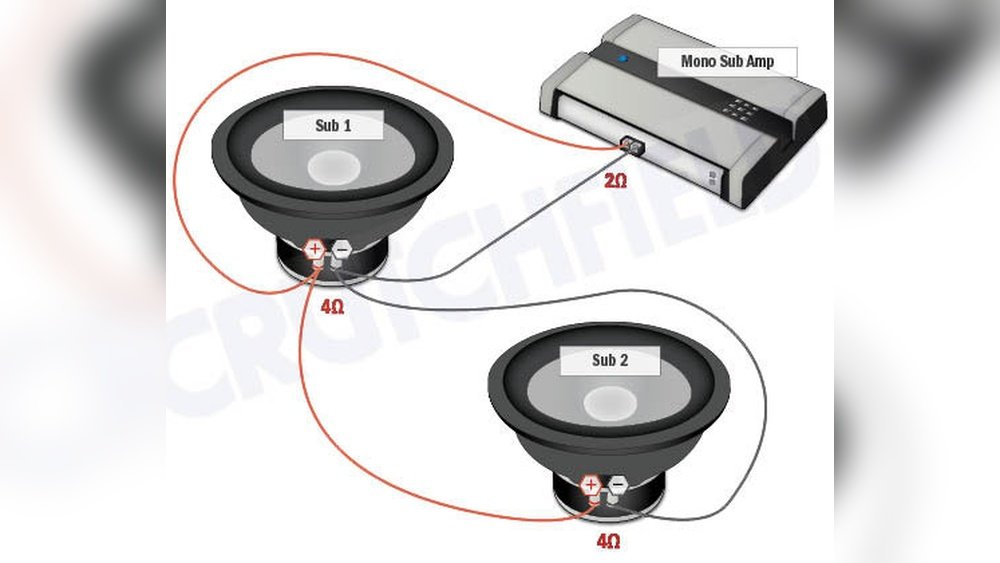
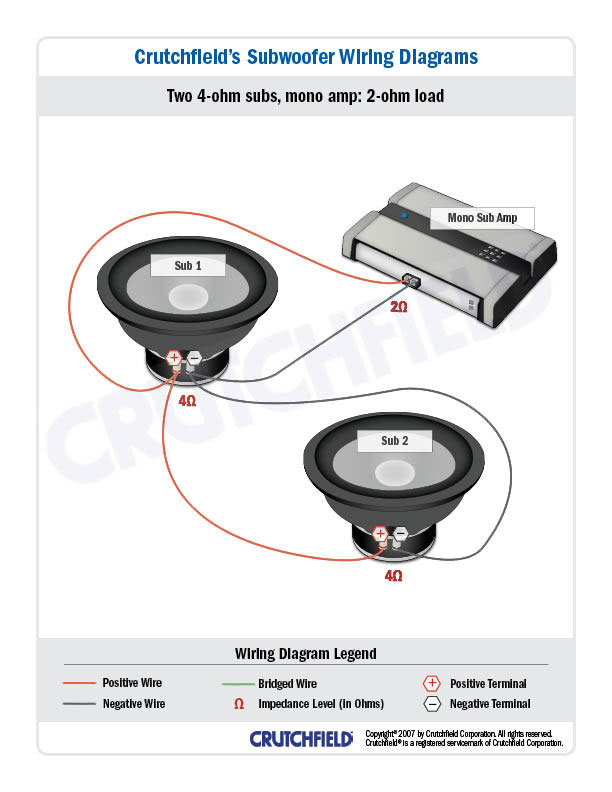
- Parallel Wiring: Connect all positives together, all negatives together, connect to amp.
- Total load: 2Ω (4Ω ÷ 2)
- Result: Most mono amps give max power at 2Ω—best for most users.
2. Two Dual Voice Coil (dvc) Subs
With two 4Ω DVC subs, you have more options.
- Series/Parallel Wiring: Wire each sub’s coils in series, then both subs in parallel.
- Total load: 4Ω
- Parallel/Parallel Wiring: Wire both coils and both subs in parallel.
- Total load: 1Ω (only if amp supports it—most don’t).
Tip: Always check your amp’s manual for safe minimum impedance!
Wiring Diagrams And Practical Examples
Here are two common setups. These diagrams make wiring clear for beginners.
Example 1: Two 4ω Svc Subs Wired In Parallel To Mono Amp (2ω Load)
- Connect both sub positives (+) to amp’s positive (+).
- Connect both sub negatives (−) to amp’s negative (−).
This setup gets you the most power from a typical mono amp.
Example 2: Two 4ω Dvc Subs Wired For A 4ω Load
- Wire each sub’s coils in series: Connect one coil’s positive to the other coil’s negative.
- Repeat for both subs.
- Then, connect both free positives to amp positive, both free negatives to amp negative.
This keeps the load safe for most amps.
Data Table: Example Subwoofer Wiring Loads
Here’s how common wiring choices affect the final impedance.
| Subwoofer Type | Impedance Each | Wiring Method | Final Load | Typical Use |
|---|---|---|---|---|
| 2 SVC | 4Ω | Parallel | 2Ω | Most mono amps |
| 2 SVC | 2Ω | Parallel | 1Ω | High-power amps only |
| 2 DVC | 4Ω | Series/Parallel | 4Ω | Safe, less power |
| 2 DVC | 2Ω | Series/Parallel | 2Ω | Most mono amps |
Non-obvious insight: If your amp is not stable at 1Ω, wiring to 1Ω can overheat or destroy it. Always stay within your amp’s safe zone.
Credit: www.crutchfield.com
Step-by-step Wiring Instructions
Let’s wire two subs to a mono amp step by step. This example uses two 4Ω SVC subs wired in parallel for a 2Ω load, the most common setup.
- Turn off power: Disconnect your amp’s power wire from the battery or wall.
- Prepare wires: Cut speaker wire, strip ends.
- Connect subs: Run one wire from Sub 1 positive to Sub 2 positive. Do the same for negatives.
- Connect to amp: Run a wire from combined positives to amp’s speaker positive. Repeat for negatives.
- Secure connections: Use crimp connectors or tape.
- Double-check: Make sure no wires touch each other or metal.
- Reconnect power: Turn on the amp, test for sound.
Tip: Use a multimeter to check your final impedance before powering up.
Common Mistakes And How To Avoid Them
Beginners often make wiring errors that can cause poor sound or damage equipment. Here’s what to watch for:
- Mismatched subs: Always use subs with the same impedance and power rating.
- Incorrect wiring: Series and parallel look similar but give different results.
- Ignoring amp limits: Never wire below your amp’s rated impedance.
- Loose wires: Can cause popping or cut-out. Always tighten screws.
- No fuse: Always use a fuse on your power wire to prevent fires.
Mono Amp Power Output Comparison
Mono amps give different power at different loads. Here’s a real data example for a common mono amp:
| Load (Ohms) | Power Output (Watts RMS) | Typical Usage |
|---|---|---|
| 4Ω | 300W | Safe, low power |
| 2Ω | 500W | Max for most setups |
| 1Ω | 700W | Only for 1Ω stable amps |
Non-obvious insight: Running your amp at its lowest possible impedance can create more heat and reduce life span. Use the 2Ω setting unless you’re sure your amp and wiring can handle 1Ω.
Choosing The Right Gauge Wire
Wire size matters for safe and strong bass. If wires are too thin, you lose power or risk overheating.
- 12-gauge wire: Best for runs up to 20 feet for most sub setups.
- 14-gauge wire: Okay for short runs or small amps.
- Thicker wire (10-gauge): Needed for high-power systems.
Tip: Always use oxygen-free copper (OFC) wire for best sound and safety.
Matching Sub Power To Amp Power
A common question is, “Will my amp blow my subs?” Here’s how to match them:
- Amp’s RMS power at your final impedance (e.g., 2Ω) should be about 80–100% of the combined subwoofer RMS.
- For example, if you have two 250W RMS subs (500W total), choose an amp that gives 500W RMS at 2Ω.
Example: Two 4Ω SVC subs, each 250W RMS, wired in parallel to 2Ω. You need a mono amp that delivers 500W RMS at 2Ω.
Practical Tips For Better Results
- Check polarity: If one sub is wired backward, bass will cancel out. Both subs must have positive to positive and negative to negative.
- Use quality enclosures: Good sub boxes make a huge difference in sound.
- Avoid cheap wires: Poor wires add noise and lose power.
- Test before sealing: Play music and check for rattles or weak bass before closing everything up.
Safety Precautions
- Always disconnect power before wiring.
- Don’t touch bare wires when testing.
- Use fuses on both power and ground wires.
- Route wires away from sharp edges and moving parts.
Real-world Example: Car Audio Upgrade
Let’s say you install two 4Ω SVC subs (each 250W RMS) with a mono amp that gives 500W RMS at 2Ω in your car.
- Wire both subs in parallel for a 2Ω load.
- Use 12-gauge wire for all connections.
- Place subs in a sealed or ported box.
- Set amp gain to match sub RMS (not max volume).
- Enjoy clean, powerful bass with no distortion.

Credit: www.youtube.com
When To Consider A Professional Installer
While wiring two subs is not hard, consider hiring a pro if:
- You’re unsure about wiring diagrams or amp specs.
- You need custom sub boxes or hidden wiring.
- Your amp or car has advanced features (DSP, factory integration).
A pro can save you time and protect your investment.
More Resources For Beginners
If you want to dive deeper, check your subwoofer and amp manuals for wiring diagrams. For more on ohm’s law and power handling, check resources like Wikipedia’s subwoofer page.
Frequently Asked Questions
How Do I Know If My Amp Can Handle Two Subs?
Check your amp’s manual for its minimum impedance rating (e.g., 2Ω stable). Make sure your wiring gives the correct load. Never wire below the amp’s rating.
Can I Mix Subwoofer Brands Or Sizes With One Mono Amp?
It’s not recommended. Mixing subs with different impedance or power ratings can cause uneven sound and stress the amp. Always use matching subs.
Is Parallel Or Series Wiring Better For Two Subs?
Parallel wiring is best for most mono amps, as it gives lower impedance and more power. But only use parallel if your amp supports the lower load.
What Happens If I Wire Below My Amp’s Rated Impedance?
Your amp may overheat, shut off, or break if wired below its safe limit. Always double-check wiring and use a multimeter to confirm.
Should I Use A Capacitor With Two Subs And A Mono Amp?
A capacitor can help if your car’s lights dim during bass hits. It’s not required for everyone, but can stabilize voltage for big systems.
Wiring two subs to a mono amp is easy with the right steps. Careful planning, matching gear, and safe wiring will give you years of strong, clean bass. Take your time, follow these tips, and enjoy your music like never before.