Best 70mai Dash Cams: 10 Picks Compared in 2026
As an Amazon Associate, we earn from qualifying purchases. This post contains affiliate links – if you buy through them, we may earn a commission at no extra cost to you.
You’re choosing between 70mai dash cams that look almost the same on the shelf. What actually splits them is how many cameras record at once, what the front lens does with fast movement, and whether the seller includes a memory card or expects you to buy one. Those three things decide how the footage holds up when you need it.
Best overall: 70mai T800 – three channels record front, rear and cabin at once, with dual Sony IMX678 sensors and a 256GB card already in the box.
Best for solo drivers: 70mai A810S – one front camera at 4K and 60FPS keeps fast highway scenes smooth, and the rotating lens covers more of the cabin.
Best for parking: 70mai M800S – built-in 128GB eMMC storage removes the card, and STARVIS 2 with an F1.7 aperture pulls detail out of dark streets.
The rest of this guide walks through each model’s real trade-offs, then answers the questions buyers ask before ordering.
How We Picked
We compared the dash cam listings and kept the ones whose sellers state the facts a buyer actually needs. A listing earned its place by naming the sensor, the resolution and frame rate of each channel, what comes in the box, and what the warranty covers. Vague claims about “crystal clarity” with no sensor or resolution behind them didn’t make the cut.
Separately sold accessories counted against a listing’s completeness, not against the camera itself. Several models unlock their remote and parking features only with a hardwire or 4G kit, so we noted which ones say that plainly instead of burying it. Cards included in the box, built-in storage, and stated temperature ranges also shaped the final order.
The last cut was overlap. Two models with the same channel count, the same sensor family and the same included card leave a reader with nothing to decide on, so we kept the one whose listing was more specific about what it does. What’s left is ten cameras that split on coverage, frame rate and storage rather than on marketing language.
1. 70mai 4K T800 3 Channel Dash Cam

Best for: Rideshare and taxi drivers wanting three angles
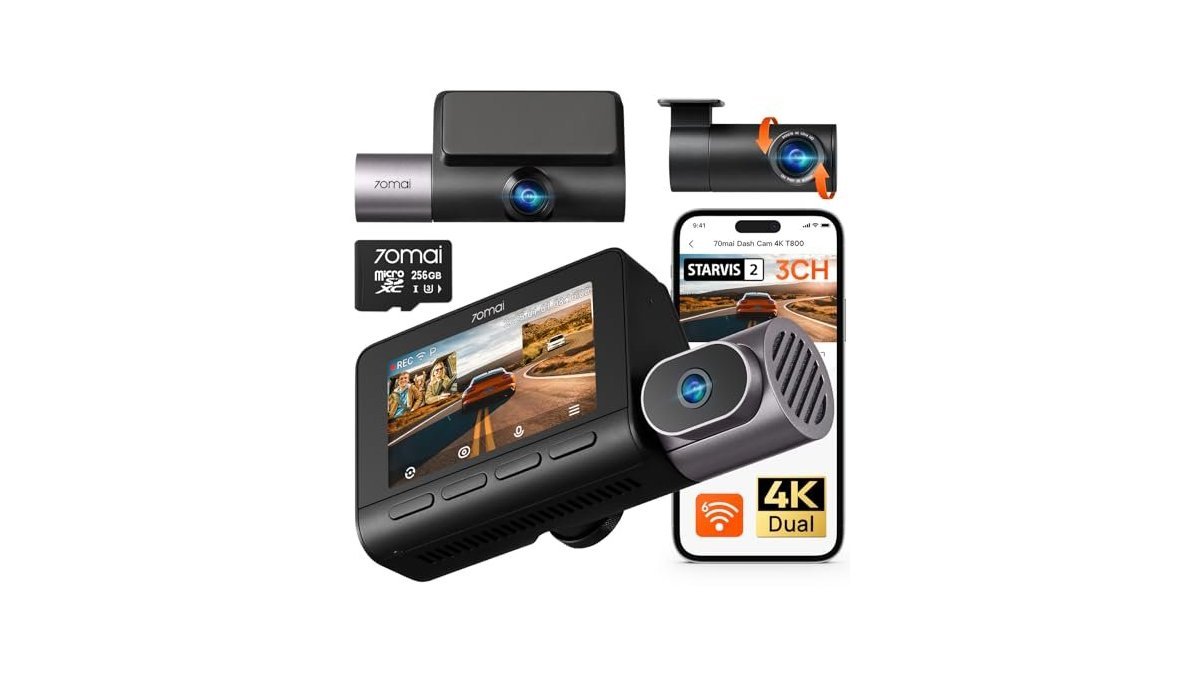
This is the only pick here that records three channels at once — 4K front, 4K rear and 1080P inside — so a single unit covers the road ahead, the road behind and whoever is in the back seat. Two Sony IMX678 STARVIS 2 sensors sit behind the front and rear lenses, and the listing pairs them with 3-channel HDR for tunnels and night driving.
The cabin camera uses four 940nm infrared lights that switch on in darkness, which is the part that matters if you drive passengers at night. A 256GB card comes in the box, so there’s no separate purchase before the first drive.
The trade-off is what the extras ask of you. The listing states that 24/7 parking alerts and 4G live view need a hardwire kit or 4G kit, sold separately. Buy this for the front, rear and cabin coverage, not for the remote features, unless you plan to add the kit.
Pros
- Front, rear and cabin cameras record together
- 256GB memory card included in the box
- Infrared cabin camera for dark back seats
Cons
- 4G and parking alerts need a separately sold kit
- Dual 4K files fill storage faster than single-channel footage
2. 70mai Dual Dash Cam Front and Rear 4K

Best for: Highway drivers who want smooth fast-motion video
The front camera records 4K at 60 frames per second, which is the number that matters when a plate flashes past at speed. Most dash cams half that rate, and the difference shows in whether a moving plate stays readable frame to frame. The listing adds ROI technology that sharpens the plate area specifically.
The front lens sits on a 340° rotation, so you can swing it toward the cabin or the side window instead of buying a second camera. A 146° field of view covers eight lanes, and the listing includes a 128GB card.
This isn’t the pick for someone who wants rear coverage without thinking about it. The rotating front is the feature the listing leads with, and the 4G remote features still need the separately sold hardwire kit.
Pros
- 4K front recording at 60 frames per second
- Rotating lens reaches 340° for cabin or side views
- 128GB card included, U3 recommended
Cons
- 4G and remote alerts need a separately sold kit
- 60FPS front files are large to transfer and store
3. 70mai A900 4K+4K Dash Cam Front and Rear

Best for: Buyers who want both cameras at 4K
Both the front and rear cameras record at 4K here. If a rear-end hit is the accident you’re worried about, the rear footage carries the same detail as the front, and the wide-angle lens on each cuts the blind spots at the corners.
The listing names 70mai Lumi Vision and Owl Night Vision algorithms for low-light work, plus built-in GPS that stamps speed and route into the files. App control handles preview and export, and voice commands keep your hands on the wheel.
Two things to plan for. The 4G module is sold separately and the listing is direct that remote viewing and alerts need it. The hardwire kit is also separate, so full parking monitoring isn’t active out of the box. The included card is 64GB.
Pros
- Front and rear both record at 4K
- Built-in GPS stamps speed and route
- 18-month limited manufacturer hardware coverage
Cons
- 4G module and hardwire kit sold separately
- 64GB card is small for dual 4K files
4. 70mai 4K Dash Cam Front and Rear

Best for: Owners who want to check the car remotely
The listing builds this one around 4G remote access — live footage, car location and instant motion or collision alerts through the companion app, from wherever you are. That’s the feature to buy it for, and the listing is clear the optional 4G hardwire kit is what unlocks it.
The front camera uses a Sony IMX678 STARVIS 2 sensor at 4K, with an IMX662 in the rear at 1080P. A large F1.7 aperture and the Lumi Vision and Night Owl Vision algorithms handle dark streets. Positioning runs on five satellite systems, so route and speed logs stay accurate in cities where one signal drops out.
Skip it if you won’t add the 4G kit — the remote features are the point, and without them you’re paying for hardware you won’t use. Installation is described as beginner-friendly, with optional in-person service in New York and California.
Pros
- 4G remote live view and instant alerts
- Five-mode positioning for accurate route logs
- Front STARVIS 2 sensor with F1.7 aperture
Cons
- Remote features need the separately sold 4G kit
- Rear channel records at 1080P, not 4K
5. 70mai 4K Dash Cam Front and Rear Inside

Best for: Family cars that want front, rear and cabin
Front, interior and rear cameras again — 4K front, 1080P interior, 1080P rear — but the listing is upfront that 4G connectivity isn’t supported, so this is the coverage pick rather than the remote-viewing one. Ultra-wide lenses and an F1.55 aperture on the front handle the light gathering.
The interior camera has switchable infrared: turn it on for clear night footage inside the car, off when you don’t need it.
A 64GB card comes included, and the slot takes up to 512GB if you want longer before loop recording overwrites. The rear camera uses a Type-C interface and mounts with adhesive, so setup is plug-and-play. Parking surveillance still needs the UP06 or UP03 hardwire kit, sold separately.
Pros
- Front, interior and rear cameras: 4K front, 1080P interior and rear
- Switchable infrared on the cabin camera
- 64GB card included, supports up to 512GB
Cons
- Listing states 4G connectivity isn’t supported
- Parking monitoring needs a separately sold hardwire kit
6. 70mai 4K Dash Cam Front and Interior

Best for: Rideshare drivers who mainly need the cabin
A two-channel setup — 4K front and 1080P interior — with no rear camera at all. That’s the honest shape of it: you get a strong front view and a clear record of who’s in the car, and nothing behind you.
The front lens runs HDR with an F1.55 aperture, and the listing pairs MaiColor Vivid+ with Night Owl Vision for tunnels and city streets at night. Parking surveillance uses time-lapse recording to keep power draw low while the car sits, which suits street parking and long-term lots.
A 64GB card is included and the slot takes up to 512GB. The warranty covers the whole unit including that card, which is worth knowing since cards are the part that usually fails first. If you need rear footage for insurance claims, this isn’t the one.
Pros
- 4K front with HDR and F1.55 aperture
- 1080P interior camera for in-cabin records
- 18-month warranty covers the included card
Cons
- No rear camera in the box
- Parking surveillance needs a hardwire kit
7. 70mai 4K Dash Cam Front and Rear

Best for: Night driving and parking without a memory card
Storage is the difference here: 128GB of eMMC is built into the camera, so there’s no card to buy, swap or lose. The listing argues built-in storage is faster and more durable than a removable card, and it removes the most common cause of a dash cam quietly stopping.
The front sensor is a STARVIS 2 IMX678 with an F1.7 aperture, and Lumi Vision processing targets plates and road signs after dark. Both front and rear lenses carry HDR, so the 1080P rear doesn’t blow out under headlights behind you.
Remote monitoring still needs the optional 4G module, sold separately, and the listing says. GPS is built in and stamps route, speed and location into every file, which pairs with parking mode to time and place each event.
Pros
- 128GB eMMC storage built in, no card needed
- STARVIS 2 front sensor with F1.7 aperture
- HDR on both front and rear lenses
Cons
- Remote monitoring needs the separately sold 4G module
- Rear channel records at 1080P, not 4K
8. 70mai A810 Lite 4K Dash Cam Front and Rear

Best for: First-time buyers who want simple setup
The listing describes a credit-card-sized body that tucks behind the rearview mirror without blocking your view, and a setup a beginner can finish in minutes. For a first dash cam, that matters more than a spec sheet.
Recording is 4K front and 1080P rear, with an F1.55 aperture and HDR for night and rain. Wi-Fi 6 transfers at up to 25MB/s per the listing, so you can pull a clip to your phone without removing the card. GPS runs on three modes — GPS, GLONASS and BDS — for speed and route logs.
Parking mode offers two routes: G-sensor detection that locks impact clips, or time-lapse for low-power continuous monitoring. Both need the UP03, UP05 or UP06 hardwire kit, sold separately. The listing also notes low-voltage protection to avoid draining your battery.
Pros
- Compact body hides behind the rearview mirror
- Wi-Fi 6 transfers at up to 25MB/s
- Low-voltage protection for parked monitoring
Cons
- Parking mode needs a separately sold hardwire kit
- Rear channel records at 1080P, not 4K
9. 70mai 4K Dash Cam Front and Rear with STARVIS

Best for: Buyers who want dual 4K on a screen
This one has a 3-inch IPS screen on the body, so you can check footage without pulling out your phone — a real difference if you’d rather not rely on an app at the roadside. The front records 4K, and the flip rear camera lets you point it inside the car or out the back.
The sensor is a Sony IMX415 behind a 7-glass F1.8 lens. The listing says the camera detects sudden brightness changes and adjusts, which is the tunnel-and-exit problem most dash cams handle badly. ADAS gives voice alerts for lane drift and closing distance.
No card is included — the listing says SD cards aren’t included and supports 32GB to 256GB, with U3 or higher recommended. Parking mode needs the UP03 hardwire kit, also separate. Budget for both before you order.
Pros
- 3-inch IPS screen for on-camera playback
- Flip rear camera points inside or behind
- Dual-band 5GHz and 2.4GHz Wi-Fi
Cons
- No memory card included in the box
- Parking mode needs the separately sold UP03 kit
10. 70mai 2.7K Dash Cam Front and Rear

Best for: Everyday commuters who want a card included
Front recording is 2.7K rather than 4K, and the listing pairs a Sony IMX675 sensor with a 6-glass F1.8 lens and HDR.
Wi-Fi and GPS are built in, so you can preview and download through the app and get speed and route data in the files. The G-sensor locks footage on impact and keeps those clips separate from the routine recordings.
Parking surveillance uses time-lapse plus collision detection, and the listing states the UP05 hardwire kit is required — it’s not in the box. The card slot takes 32GB to 256GB if you want more room later.
Pros
- 64GB card included in the box
- Sony IMX675 sensor with HDR and F1.8 lens
- Smaller 2.7K files stretch card capacity
Cons
- Front records at 2.7K, not 4K
- Parking mode needs the separately sold UP05 kit
How to Choose in Sixty Seconds
Do I need three channels or two?
Count the angles you’d actually review after an incident. A three-camera setup — like the T800 and T800E — records the road ahead, the road behind and the cabin, which covers a rear-end hit and a passenger dispute from one unit. Two channels drop the cabin or the rear. If you drive passengers for money, the cabin camera is the one that settles arguments. If you mostly drive alone on a highway, the rear camera matters more than the cabin, and a front-and-rear setup is enough.
Does 60FPS really matter?
It matters most at speed. The A810S records its front channel at 4K and 60FPS for exactly this. If your driving is mostly city traffic and short trips, the difference is smaller and you can weigh other features first.
What do I have to buy separately?
Check the box contents before ordering, because 70mai splits its accessories. Parking surveillance on most models here needs a hardwire kit — the UP03, UP05 or UP06 — and remote live view needs the 4G kit. The 70mai T800 and 70mai A810S include memory cards; the 70mai A800S does not. The 70mai M800S skips the card question entirely with 128GB built in. Writing down what’s in the box versus what you’ll add later is the fastest way to compare these fairly.
Frequently Asked Questions
How much footage fits on the included card?
It depends on resolution and how many channels record at once. The 70mai T800 includes a 256GB card, the largest here, which suits its three simultaneous channels. The 70mai A810S includes 128GB, the 70mai A900, 70mai T800E and 70mai A810 include 64GB each, and the 70mai A500S also includes 64GB. The 70mai M800S uses 128GB of built-in eMMC storage instead of a card. The 70mai A800S ships without a card and supports 32GB to 256GB.
What does the hardwire kit actually change?
It changes whether the camera keeps watching after you switch the engine off. Without it, parking surveillance on the 70mai T800, 70mai A900, 70mai M800, 70mai T800E, 70mai A810, 70mai A810 Lite, 70mai A800S and 70mai A500S stays inactive, because each of those listings states a hardwire kit is required. The 70mai M800S and 70mai A810S also name a separately sold kit for their parking and remote features.
What tends to fail first on a dash cam?
Heat and storage are the two things the listings address most directly. 70mai uses supercapacitors rather than lithium batteries across most of this range, and states an operating range of 14°F to 140°F — the 70mai T800, 70mai A810S, 70mai T800E and 70mai A810 Lite all name that figure. The 70mai M800S listing argues its built-in 128GB eMMC is faster and more durable than a removable card.
Is the simplest camera on this list enough?
For a lot of drivers, yes. The 70mai A500S records 2.7K front and rear with an included 64GB card, Wi-Fi, GPS and a G-sensor, which covers the core job of documenting a collision. The 70mai A810 Lite adds 4K front recording and Wi-Fi 6 in a compact body that’s easy to install. What you give up is the third channel, the higher frame rate and the built-in storage.
Closing
For most drivers, the 70mai T800 is the pick — three channels, dual STARVIS 2 sensors and a 256GB card in the box cover the angles that matter. If you drive alone and want the sharpest fast-motion front footage, the 70mai A810S and its 60FPS recording is the better fit. Before you order, read the box contents on the listing you’re buying from and note which accessories are sold separately.