
Thinking of Adding a Subwoofer to a Factory Stereo: Expert Guide
Thinking Of Adding A Subwoofer To A Factory Stereo
Many car owners enjoy their music but feel something is missing from their factory stereo. The bass is weak, and the sound lacks depth. If you’re considering adding a subwoofer to a factory stereo, you’re not alone. This upgrade can transform your driving experience, making every song feel richer and more exciting. But before you jump in, it’s important to understand the basics, challenges, and solutions.
Why Add A Subwoofer To A Factory Stereo?
Most factory stereos are built for cost efficiency, not sound quality. They often use small, low-powered speakers. While these are fine for podcasts or talk radio, they struggle with music that needs strong bass. A subwoofer is a speaker designed to play low-frequency sounds. It can add punch and warmth to your music.
Key Benefits
- Stronger bass: Feel the beat in your chest, not just your ears.
- Fuller sound: Subwoofers handle low notes, so your other speakers play mids and highs better.
- More enjoyable music: Every genre, from hip-hop to rock to classical, sounds more dynamic.
Example
Imagine playing your favorite song. With just factory speakers, the bassline is barely there. Add a subwoofer, and suddenly the song feels alive—every drum hit and bass note is clear.
Understanding Factory Stereo Limitations
Before upgrading, it’s helpful to know why factory systems fall short.
Common Weaknesses
- Small speakers: Most are 4–6 inches, not built for deep bass.
- Limited power: Factory stereos often have low-powered amplifiers.
- Basic equalization: Little control over bass or treble frequencies.
Data Example
A typical factory stereo might produce only 10–20 watts RMS per channel. Most subwoofers require at least 100–250 watts RMS to perform well.
Why Not Replace Everything?
Replacing the entire system is expensive and complicated. Many drivers want better bass without changing everything else. Adding a subwoofer is a practical solution.
Can You Add A Subwoofer To A Factory Stereo?
The short answer is yes. Even if your car stereo doesn’t have special outputs, you can still add a subwoofer. Most modern subwoofer amplifiers can connect to factory systems using different methods.
Key Connection Methods
- Line output converter (LOC): Converts speaker signal to a level the amplifier accepts.
- High-level (speaker-level) inputs: Some amps accept direct speaker wire connections.
- Factory subwoofer integration: If your car already has a factory sub, you may tap into its wiring.
Simple Example
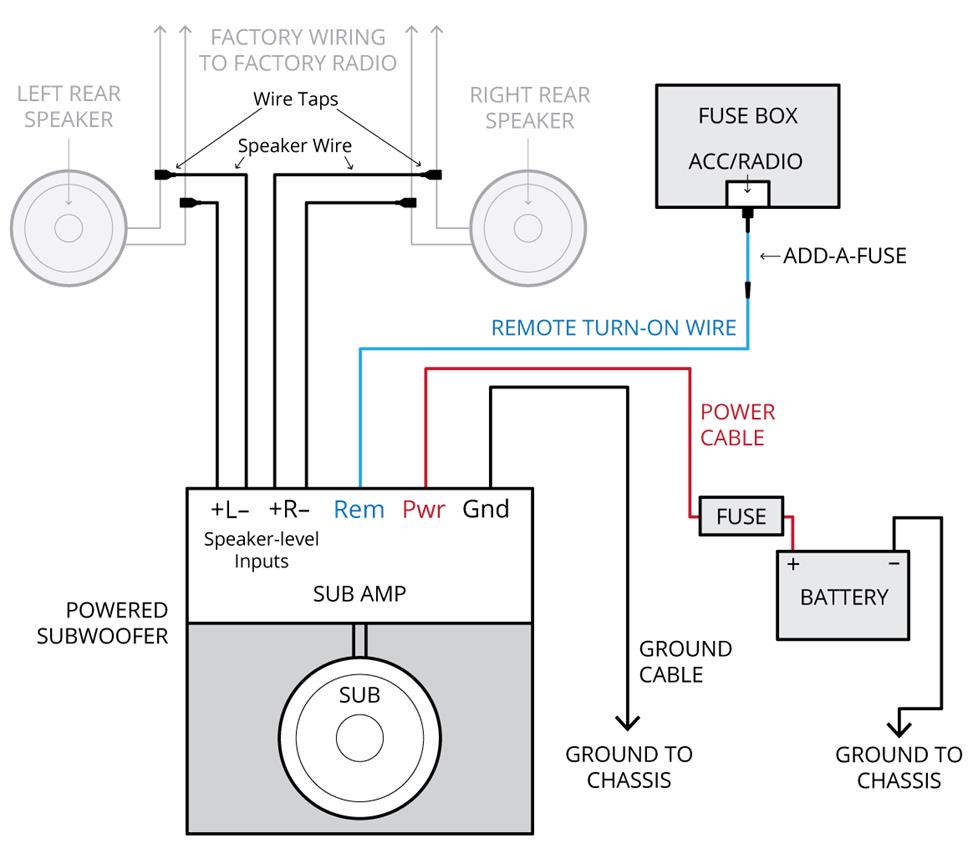
You use a line output converter to connect the rear speaker wires to your new subwoofer amplifier. The LOC turns the high-power signal into a lower-power signal the amp can use.
Choosing The Right Subwoofer
Not all subwoofers are the same. Picking the right one depends on your needs, budget, and car.
Key Considerations
- Power handling: Match the subwoofer’s RMS rating to your amplifier’s output.
- Size: Common sizes are 8″, 10″, and 12″. Bigger subs make deeper bass but need more space.
- Type:
- Powered subwoofers: Built-in amp, easy to install.
- Passive subwoofers: Need an external amplifier, more flexible.
- Enclosure:
- Sealed: Tight, accurate bass.
- Ported: Louder, deeper bass, but larger.
Example Table: Subwoofer Size Vs. Bass Output
| Subwoofer Size | Bass Depth | Space Required |
|---|---|---|
| 8 inches | Moderate | Small |
| 10 inches | Good | Medium |
| 12 inches | Deep | Large |
Practical Insight
If you drive a compact car, an 8-inch powered subwoofer under a seat can add bass without taking much space. For SUVs or trucks, a 12-inch sub in a ported box offers much more power.

Credit: volunteeraudio.com
Amplifiers: The Power Behind The Bass
A subwoofer needs more power than factory stereos provide. That’s why you need an amplifier.
Types Of Amplifiers
- Mono (single-channel): Best for subwoofers.
- Multi-channel: Can run both subs and other speakers.
Matching Amplifier And Subwoofer
- RMS rating: Match the amp’s RMS output to the sub’s RMS handling.
- Impedance (ohms): Most subwoofers are 2 or 4 ohms. Match the amp’s output to this.
Comparison Table: Amplifier Vs. Factory Stereo Output
| Source | Typical RMS Power | Suitable for Subwoofer? |
|---|---|---|
| Factory Stereo | 10–20 watts/channel | No |
| Aftermarket Amplifier | 100–500 watts/channel | Yes |
| Powered Subwoofer | 100–250 watts (built-in) | Yes |
Common Mistake
Some beginners buy a strong subwoofer but connect it to a weak amp. This leads to poor sound and can damage both. Always check the specs.
Installation Steps: Adding A Subwoofer
Adding a subwoofer to your factory stereo is possible for most DIYers. Here’s how it’s usually done.
1. Gather The Right Parts
- Subwoofer
- Amplifier (unless using a powered sub)
- Amplifier wiring kit (power cable, ground wire, fuse, RCA cables)
- Line output converter (if needed)
- Speaker wire
2. Connect To Factory Stereo
- Find rear speaker wires or the factory subwoofer wiring.
- Use an LOC or speaker-level inputs to get a signal for your amplifier.
3. Run Power To The Battery
- Use a thick power cable (usually 8 or 4 gauge).
- Add an inline fuse near the battery.
- Run the cable through the firewall into the car.
4. Ground The Amplifier
- Bolt the ground wire to bare metal in the car, close to the amplifier.
5. Connect Everything
- Run RCA or speaker wires from the LOC to the amplifier.
- Connect the subwoofer to the amplifier using speaker wire.
6. Adjust Settings
- Set the gain and crossover on your amplifier.
- Test with music at low volume first, then adjust as needed.
Example
A beginner installs a powered subwoofer under the seat using a wiring kit and a line output converter. The whole process takes about 2–3 hours.
Integration Challenges And Solutions
Adding a subwoofer to a factory stereo is not always plug-and-play. Here are some common issues and how to solve them.
Challenge: No Rca Outputs
Solution: Use a line output converter or an amplifier with speaker-level inputs.
Challenge: Engine Noise Or Humming
Solution: Check your ground connection. Make sure the wire is attached to clean, unpainted metal.
Challenge: Factory Stereo Turns Off Amplifier
Some factory stereos turn off the signal when they detect extra resistance.
Solution: Use a load-generating device (like a resistor harness), or choose a line output converter made for factory systems.
Comparison Table: Integration Solutions
| Problem | Common Cause | Solution |
|---|---|---|
| No RCA Outputs | Factory stereo design | Line output converter |
| Noise/Humming | Poor ground | Better grounding |
| Stereo Shuts Off | Signal detection | Resistor harness |
Cost Breakdown
Adding a subwoofer doesn’t have to break the bank. Here’s a rough idea of costs in the US:
- Powered subwoofer: $100–$300
- Subwoofer + amplifier + box: $200–$600
- Wiring kit and connectors: $30–$60
- Professional installation: $100–$200 (optional)
Example Calculation
A simple powered subwoofer installed at home can cost around $150–$350 total. A custom setup with a big sub and separate amp can be $400–$800.
Two Insights Beginners Miss
- Proper tuning matters: Installing a subwoofer is just the start. Setting gain, crossover, and bass boost correctly will prevent distortion and protect your gear.
- Electrical system limits: Adding a high-power subwoofer can stress your car’s battery or alternator. If you notice dimming headlights or slow engine cranking, you may need a power upgrade.
Common Mistakes To Avoid
- Ignoring the ground wire: A poor ground causes noise and poor amp performance.
- Overpowering the sub: Too much power can damage the subwoofer.
- Skipping the fuse: Always use a fuse on the power cable to prevent fires.

Credit: www.walmart.com
Should You Hire A Pro Or Diy?
If you feel confident with basic tools and wiring, you can install a subwoofer yourself. Many powered subs are made for beginners. If your car has a complex stereo, hiring a pro ensures everything works safely and reliably.
When To Hire A Pro
- Factory systems with advanced features (like navigation, Bluetooth, or special sound processing)
- Luxury vehicles with tight spaces or sensitive electronics
- If you want a hidden or custom installation
How Does It Affect Your Car?
A subwoofer, if installed correctly, won’t harm your car. It will use more power, but for most cars, this is not a problem. If you install a very large system, consider your car’s power limits.
Credit: www.crutchfield.com
Reliable Resources For More Information
If you want more details about car audio integration, check out the expert guides at Crutchfield.
Frequently Asked Questions
Can I Add A Subwoofer To My Car Without Changing The Stereo?
Yes. You can use a line output converter or an amplifier with speaker-level inputs. This way, you keep the factory stereo and add bass.
Do I Need A Separate Amplifier For The Subwoofer?
Usually, yes. Factory stereos don’t have enough power for a subwoofer. You can use a powered subwoofer (amp built-in) or an external amp.
Will Adding A Subwoofer Damage My Car’s Battery?
For most moderate systems, no. If you install a large, high-power sub, it can stress the battery or alternator. Watch for dimming lights or other power issues.
Is A Powered Subwoofer Good For Beginners?
Absolutely. Powered subwoofers are easier to install and require less wiring. They’re great for compact cars or if you want a simple upgrade.
Can I Remove The Subwoofer Later?
Yes. You can uninstall it and return your system to stock. Just make sure to remove all wiring safely.
Adding a subwoofer to a factory stereo is one of the best ways to improve your car’s sound without replacing everything. With the right gear and a careful approach, you’ll enjoy richer, deeper music on every drive.